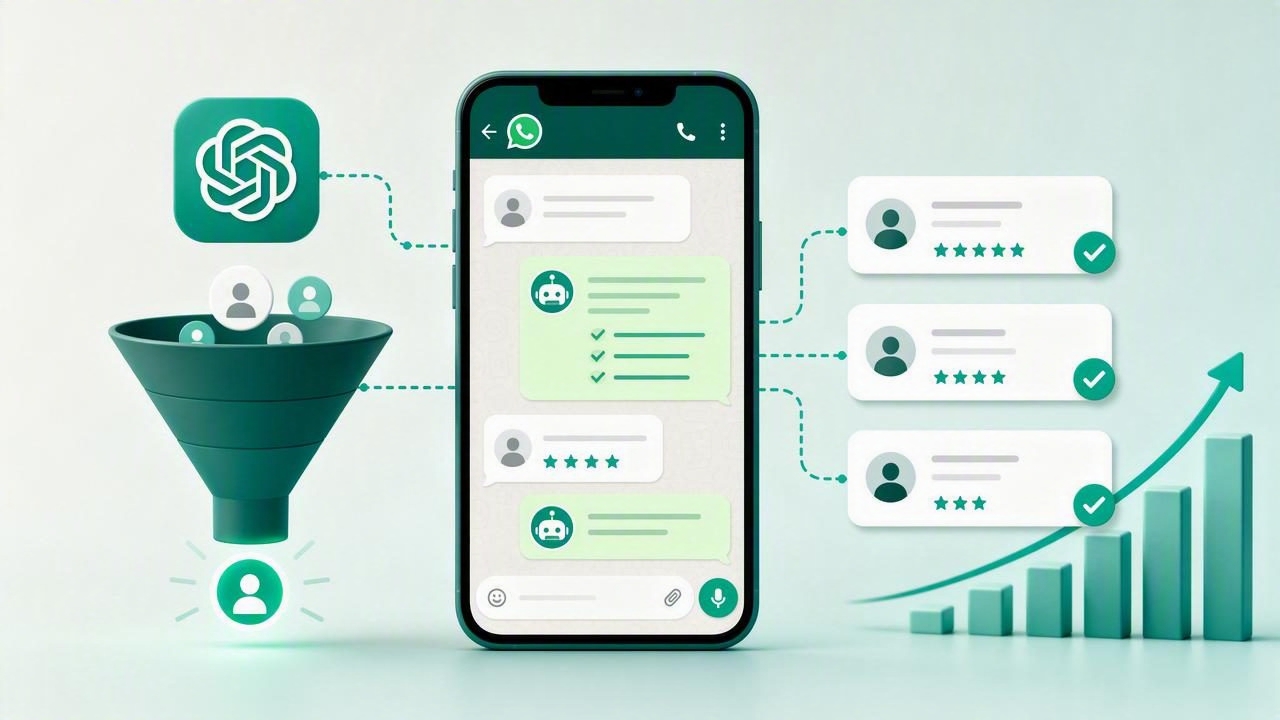
For agencies, WhatsApp lead qualification has moved beyond simple autoresponders. Prospects now expect immediate, useful answers, whether they are asking about pricing, availability, service areas, eligibility, or next steps. At the same time, agencies need a practical way to deploy these experiences across multiple client accounts without mixing data, losing brand control, or creating an unmanageable stack of one-off automations.
That is why finding the best OpenAI-compatible agent platform to qualify leads on WhatsApp is not only a model-selection decision. It is an operational, security, and scalability decision. The right platform should connect WhatsApp conversations to client-specific knowledge, apply a repeatable qualification process, route high-intent opportunities to people, and give an agency reliable control across its full client portfolio.
This guide explains what to look for, how to evaluate platforms, and how to design a WhatsApp AI agent that helps sales teams act on better-qualified leads.
What Is an OpenAI-Compatible WhatsApp Agent Platform?
An OpenAI-compatible agent platform can connect to models that use an OpenAI-style API. This generally gives agencies flexibility to choose a model provider, use compatible hosted models, or connect approved self-hosted options where appropriate. Rather than locking an agency into one proprietary AI provider, compatibility allows the model layer to be adapted as requirements around cost, speed, privacy, and quality change.
For WhatsApp lead qualification, the platform should combine that model access with several other capabilities:
- WhatsApp messaging integration for inbound conversations and approved outbound follow-up workflows.
- Client knowledge bases built from PDFs, websites, FAQs, service documents, and internal sales materials.
- Conversation instructions that define tone, qualification questions, exclusions, and escalation rules.
- Lead capture for contact details, intent, budget, location, timing, and other relevant fields.
- Human handoff when a prospect needs a person, requests a quote, or reaches a high-value stage.
- Tenant isolation and permissions so each client’s agents, conversations, and knowledge remain separate.
An agent is more than a chatbot. A useful lead-qualification agent can interpret questions, retrieve relevant information, ask follow-up questions based on prior answers, summarize the opportunity, and transfer the conversation with context.
Why WhatsApp Is Effective for Lead Qualification
WhatsApp is a natural channel for qualification because it is conversational and immediate. Many prospects prefer sending a quick message over filling out a lengthy form, waiting for an email response, or calling an unfamiliar business. This is particularly valuable for local services, real estate, education, travel, clinics, automotive, legal intake, and B2B service providers.
However, speed alone does not create qualified leads. The agent needs to guide the conversation toward information that sales teams can use. For example, a home-renovation client may need project type, property location, estimated budget, desired start date, and whether the prospect owns the property. A B2B agency may need company size, current marketing spend, target service, decision-maker status, and timeline.
The goal is not to interrogate every prospect. The goal is to remove friction while collecting enough context to decide what should happen next.
A well-designed agent delivers a consistent first response at any hour, which reduces response-time gaps and helps human teams focus on conversations that merit their attention.
Core Evaluation Criteria for Agency Use
When comparing AI agent platforms, avoid evaluating only the quality of a demo conversation. Agencies need infrastructure that supports repeatable delivery and responsible client management.
1. Multi-Client Isolation
Each client should have a logically isolated workspace or tenant. Their conversations, documents, agent instructions, integrations, and analytics should not be visible to another client. This matters for confidentiality, brand integrity, and day-to-day agency operations.
Look for clear boundaries at the data level, not merely separate labels in a shared dashboard. Also check whether agency administrators can manage multiple accounts without giving every internal user access to every client.
2. Flexible Model Connectivity
OpenAI-compatible support is useful when agencies want freedom to select models based on task requirements. A fast, cost-efficient model may be adequate for initial classification and FAQ responses, while a more capable model may be reserved for complex conversations or detailed summaries.
Ask whether the platform supports configurable API endpoints, secure credential storage, model selection by agent, and usage monitoring. Model flexibility should not make governance harder; it should enable deliberate choices.
3. Knowledge Base Quality and Controls
Lead qualification depends on accurate answers. A platform should let teams upload and organize client documents, refresh knowledge when offerings change, and limit the agent to approved sources. It should also provide instructions for uncertainty, such as asking a clarifying question or escalating rather than inventing an answer.
Good knowledge-base design is as important as the AI model. A poorly maintained document library can produce outdated prices, incorrect policies, or misleading service information.
4. Human Handoff That Preserves Context
Human handoff should be a planned workflow, not a failure state. The system should notify the right person or team, stop automated replies when needed, and include a concise summary of the conversation. A salesperson should be able to see what the prospect asked, what the agent answered, and which qualification details were collected.
Useful triggers include:
- The lead meets defined qualification criteria.
- The person asks for a quote, appointment, payment information, or contract terms.
- The agent detects frustration, a complaint, or a sensitive topic.
- The knowledge base does not contain a reliable answer.
- The lead explicitly asks to speak with a human.
5. Security, Permissions, and Deployment Options
AI agent security is especially important for agencies handling many client accounts. Review role-based access, audit logs, encryption practices, secrets management, data retention settings, and document permissions. If clients have strict security requirements, assess whether the product offers a managed cloud option, self-hosting, or both.
Self-hosted AI software can offer more infrastructure control, while managed cloud can reduce operational overhead. The best choice depends on the client’s compliance needs, technical resources, and contractual commitments.
A Practical WhatsApp Qualification Flow
The strongest qualification flows feel like helpful conversations, not rigid forms. Start by defining the few fields that materially change sales follow-up. Then write short instructions that let the agent adapt to the person’s questions and pace.
- Welcome and identify intent: Ask what the prospect needs help with.
- Answer immediate questions: Use approved knowledge to build trust before asking for details.
- Gather key qualifiers: Collect only the information needed to assess fit.
- Confirm contact preferences: Request a name, email, phone number, or preferred callback time when appropriate.
- Assign an outcome: Mark the conversation as qualified, nurture, disqualified, support, or human review.
- Hand off with a summary: Send the right information to the assigned salesperson or team.
Qualification objective:
Identify prospects seeking commercial SEO services.

Ask naturally for:
- Business website or industry
- Monthly marketing budget range
- Primary growth goal
- Desired start date

Rules:
- Do not promise rankings or guaranteed results.
- Use the knowledge base for service details.
- Escalate immediately if the prospect requests a proposal.
- Summarize qualified leads in three bullet points.
This structure gives the agent direction while leaving room for a natural dialogue. It also reduces the risk of unsupported claims and inconsistent sales messaging.
Platform Comparison Checklist
| Capability | Why It Matters | What to Verify |
|---|---|---|
| OpenAI-compatible models | Reduces model-provider lock-in | Custom endpoints, model selection, secure API keys |
| Multi-tenant architecture | Protects client separation | Isolated data, client workspaces, scoped access |
| WhatsApp integration | Enables real-time conversations | Inbox reliability, templates, opt-in compliance support |
| Knowledge retrieval | Improves answer accuracy | Document upload, source controls, update workflow |
| Human handoff | Moves high-value leads forward | Alerts, conversation ownership, summaries, pause automation |
| Deployment choice | Supports different client requirements | Managed cloud, self-hosting, documentation, updates |
Common Mistakes to Avoid
Building one generic agent for every client: Each client needs its own brand voice, qualification logic, knowledge, and escalation destinations. Reusing a baseline template is efficient; treating all clients identically is not.
Collecting too much information too early: A long sequence of questions can feel intrusive. Let the prospect state their need first, answer what is useful, and ask for details progressively.
Skipping human review processes: Agents need clear boundaries. Someone should own handoffs, monitor conversations, update knowledge, and review edge cases.
Ignoring measurement: Track first-response time, completion rate, qualification rate, handoff rate, booked meetings, and sales acceptance. These metrics reveal whether the agent is creating genuine pipeline value.
Assuming the model solves governance: Even an excellent model cannot compensate for weak permissions, mixed client data, vague instructions, or inaccurate source material.
How Agencies Can Scale the Service
Agencies can turn WhatsApp AI lead qualification into a repeatable service by creating standardized onboarding assets: a client intake form, knowledge-base checklist, qualification worksheet, prompt template, handoff matrix, and monthly performance report. This makes delivery faster while preserving customization where it matters.
Define ownership early. The client should approve service facts, pricing language, and escalation contacts. The agency should manage configuration, optimization, reporting, and operational quality. This division helps avoid stale knowledge and unclear accountability.
As volume grows, separate agent performance by client and use consistent reporting definitions. A “qualified lead” should mean the same thing in the report as it does in the client’s sales workflow. That alignment is what turns conversations into measurable recurring value.
Choosing the Right Foundation
The best platform is not necessarily the one with the flashiest demo. It is the one that helps your agency safely operate branded WhatsApp agents across clients, connect appropriate AI models, keep knowledge accurate, and involve humans at the right moment.
Prioritize tenant isolation, permission controls, practical knowledge management, transparent model flexibility, and dependable handoff workflows. Then test the platform with realistic client scenarios, including ambiguous questions, unsupported requests, high-intent leads, and requests for human help.
For agencies seeking an open-source approach with managed-cloud and self-hosted deployment paths, OpenLivery is one option to evaluate alongside the checklist above.
