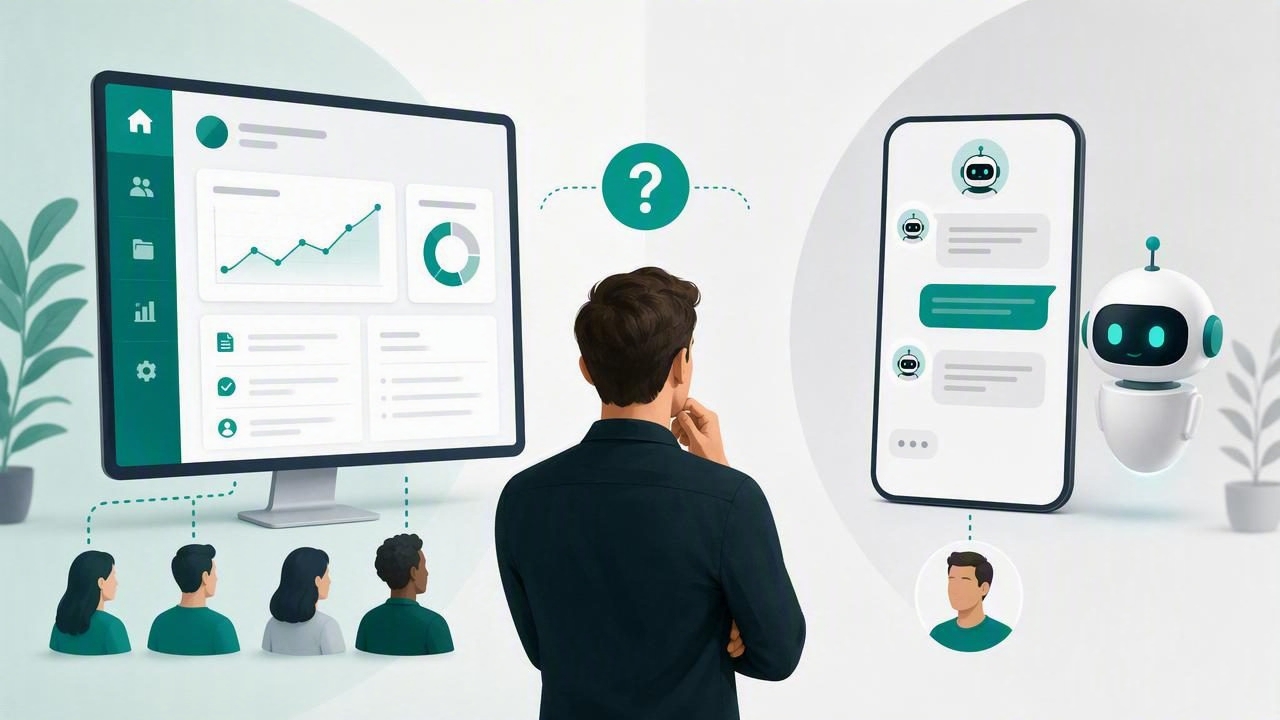
For an agency delivering AI automation, the technology behind an agent is only part of the product. Clients also evaluate how they access it, review results, update knowledge, manage conversations, and maintain confidence in their data. That is why the decision between a branded client portal vs single-client chatbots has major consequences for operational efficiency, client retention, and recurring revenue.
A single-client chatbot can be an excellent starting point for a small engagement. It is quick to configure, simple to explain, and focused on one customer’s immediate use case. However, agencies serving multiple accounts often outgrow this model. A branded client portal provides a more structured way to deliver isolated AI agents, client knowledge bases, permissions, analytics, and human handoff workflows at scale.
This guide explains the practical differences, where each approach works best, and how to choose a delivery model that supports sustainable agency growth.
What Is a Single-Client Chatbot?
A single-client chatbot is an AI assistant deployed for one organization, brand, or use case. It may live on a website, in WhatsApp, within a social messaging channel, or behind a simple shared dashboard. The agency commonly configures the model, prompts, documents, and integrations directly for the client.
For example, a local real estate agency may use a WhatsApp AI agent to answer property questions, capture budget and location preferences, and route qualified leads to a sales representative. The client may not need a full administrative workspace; the agency can handle most updates on its behalf.
This approach is usually optimized for speed. The chatbot is the core deliverable, while the surrounding management experience is minimal.
Typical strengths of single-client chatbots
- Fast setup for a single, well-defined business need.
- Lower initial complexity for clients with limited technical requirements.
- Easy proof of concept for testing an AI use case.
- Fewer features to train clients to use.
- Suitable for one-off projects or highly managed services.
What Is a Branded Client Portal?
A branded client portal is a dedicated, agency-controlled workspace where each client can access and manage its AI services under the agency’s identity. Rather than receiving only a chatbot link or messaging number, the client gets a structured environment for its agents, conversations, documents, user access, settings, and performance information.
For agencies, the key word is isolation. Each customer should have separate agents, separate knowledge sources, separate conversation data, and role-based permissions. A portal also gives agency teams a consistent operational layer for onboarding new clients and supporting existing ones.
The portal does not replace channels such as WhatsApp. Instead, it supports them. A client’s prospects may chat with an AI agent on WhatsApp, while the client’s team uses the portal to review handoffs, upload updated service documents, and check whether leads are being qualified correctly.
Clients do not only buy an AI agent’s answers. They buy confidence that the system is organized, accessible, secure, and aligned with their brand.
Branded Client Portal vs Single-Client Chatbots: Core Differences
| Area | Single-Client Chatbot | Branded Client Portal |
|---|---|---|
| Primary focus | One deployed assistant | A repeatable client AI service environment |
| Client access | Usually limited to the chat channel | Dedicated workspace with controlled access |
| Knowledge management | Agency-managed or ad hoc | Structured client knowledge base workflows |
| Multi-client operations | Often manual across separate tools | Designed for consistent account separation |
| Branding | May show vendor or generic interfaces | Can be white-labeled around the agency brand |
| Human handoff | May require external processes | Can be tracked and managed centrally |
| Scalability | Effective for a few bespoke accounts | Better for standardized service delivery |
| Revenue model | Often project-based | Supports ongoing managed-service subscriptions |
Why a Client Portal Matters as an Agency Scales
When an agency has two or three AI chatbot clients, separate spreadsheets, folders, credentials, and message inboxes may be manageable. At 20 or 50 clients, that approach introduces operational risk. Team members can lose track of which documents belong to which client, what prompt changes were approved, or who should receive an escalated conversation.
A branded portal creates a repeatable operating model. Onboarding can follow the same sequence for every account: create a workspace, assign users, add the knowledge base, configure the agent, connect messaging, define escalation rules, and review test conversations.
This consistency helps agencies reduce delivery time without sacrificing quality. It also makes it easier to delegate work to account managers, implementation specialists, and client support teams.
Benefits for client retention
A portal can make an AI service feel more tangible and valuable. Instead of seeing automation as a black box, clients can participate in maintaining it. They may upload a revised pricing PDF, identify an incorrect response, review leads awaiting attention, or give a colleague limited access to a specific workspace.
That visibility supports better collaboration. It also makes the agency relationship less dependent on individual email threads and informal support requests. A well-structured portal turns AI management into an ongoing business process, which can strengthen retention and justify recurring monthly fees.
When a Single-Client Chatbot Is the Better Choice
A client portal is not always necessary. For some engagements, a focused chatbot remains the right solution. The goal is not to add software layers for their own sake; it is to match the delivery model to the client’s needs and the agency’s operating plan.
Choose a single-client chatbot when:
- The client needs a fast pilot with one clear success metric.
- The agency will fully manage prompts, content, and optimization.
- There are few or no client-side users who need administrative access.
- The project is temporary, such as an event, campaign, or seasonal promotion.
- The client has a very simple knowledge base and escalation process.
- The agency is validating demand before productizing a larger service.
For instance, a restaurant running a two-month WhatsApp booking campaign may only need an agent and a human escalation number. Building a full portal could delay the launch without creating proportional value.
When a Branded Client Portal Is the Better Choice
A client portal becomes more compelling when the AI service is expected to be continuous, collaborative, or repeatable across many accounts. It is particularly useful for agencies building a white-label AI agent offer rather than selling isolated chatbot projects.
Consider a portal-first model when:
- You manage AI agents for multiple clients and need reliable tenant separation.
- Clients need to upload or update their own documents and FAQs.
- Several stakeholders need different levels of access.
- Human handoff queues require visibility and accountability.
- Your team needs a standard onboarding and support workflow.
- You want to package AI services as a monthly managed solution.
In this model, the agency can standardize the foundation while preserving client-specific branding, knowledge, agent instructions, and workflows. That is the balance that makes multi-client agency operations scalable.
Security and Data Isolation Are Non-Negotiable
One of the most important factors in the branded client portal vs single-client chatbots decision is data governance. A chatbot may be simple, but simplicity must never mean mixing customer information. Agencies handling lead details, sales conversations, internal documents, or customer support data need clear boundaries between accounts.
Evaluate an AI platform’s isolation model carefully. At a minimum, each client should have distinct knowledge sources, conversation records, user roles, and agent configurations. Agency administrators may need cross-client visibility, but client users should only see their own workspace.
Questions to ask before choosing a platform
- Can one client ever retrieve another client’s documents or conversations?
- Are permissions assigned by workspace, role, and user?
- Can access be revoked immediately when a staff member leaves?
- Are human handoffs securely routed to the correct team?
- Can the agency audit changes to prompts, knowledge, and settings?
- Does the platform support managed cloud deployment and, where required, self-hosting?
For organizations with strict security requirements, self-hosted AI software can offer greater infrastructure control. For agencies prioritizing speed and reduced operational overhead, a managed AI agent cloud may be the more practical option. The right choice depends on client expectations, internal expertise, and compliance obligations.
Build a Practical Hybrid Delivery Model
Many agencies do not need to choose one model forever. A practical approach is to start with a single-client chatbot as a discovery offer, then move successful clients into a branded portal as their usage grows.
For example, an agency can begin with a WhatsApp lead qualification agent. After the client proves that the agent generates qualified opportunities, the agency can introduce portal access for knowledge updates, lead review, additional team members, and performance reporting.
Pilot chatbot → Validate lead flow → Add human handoff →
Create client workspace → Enable knowledge updates → Expand service
This progression reduces friction at the beginning while creating a clear path toward a higher-value managed AI service.
Final Decision Framework
Use a single-client chatbot when speed, simplicity, and hands-on agency management matter most. Use a branded client portal when you need repeatable onboarding, client autonomy, secure data separation, and a scalable recurring-revenue offer.
The strongest agency strategy is not simply deploying more chatbots. It is designing an experience that makes AI agents easy to manage, safe to operate, and valuable to clients over time. Platforms such as OpenLivery are built around this multi-client model, combining isolated agent workspaces with WhatsApp deployment, knowledge bases, and human handoff capabilities.
