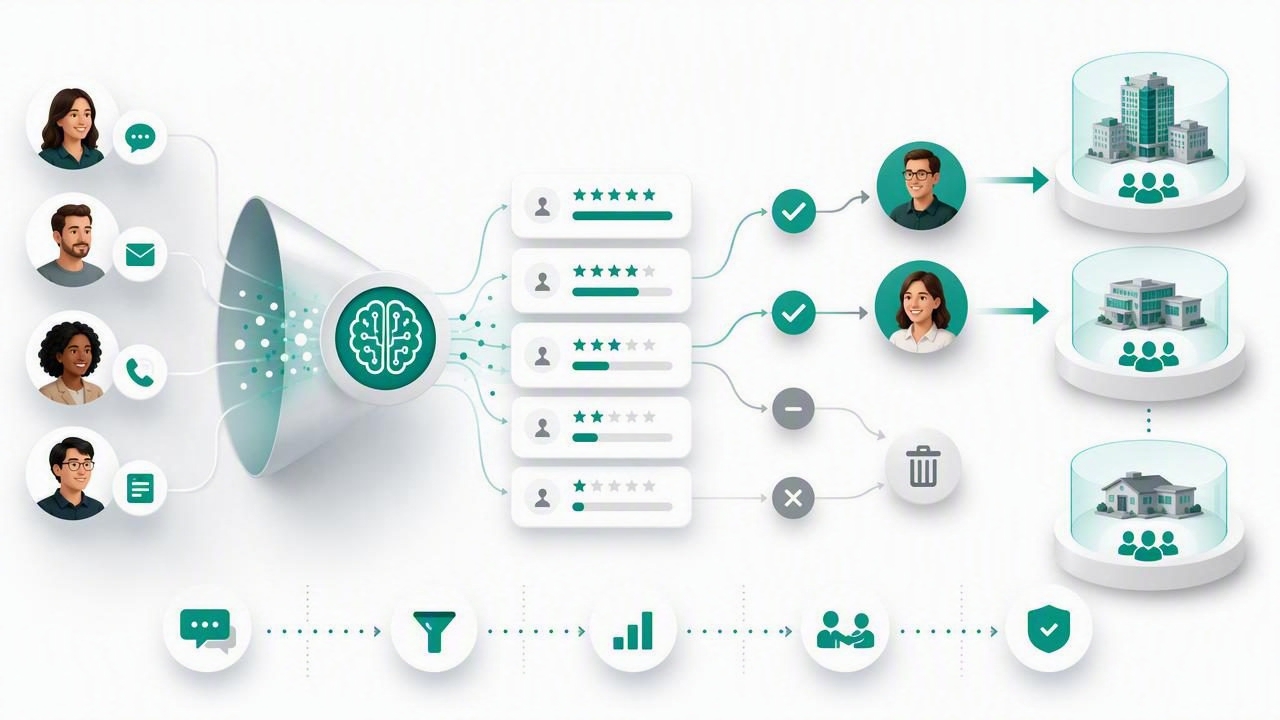
Agencies increasingly use conversational AI to help clients respond to inbound leads faster, capture essential details, and route high-intent prospects to sales teams. But delivering a chatbot for one client is very different from creating an AI lead qualification system for repeatable agency delivery.
Repeatability requires more than a polished conversation. An agency needs a structured operating model: reusable qualification frameworks, client-specific knowledge, clear escalation rules, secure data separation, measurable outcomes, and a deployment process that does not require rebuilding everything from scratch.
This guide explains how agencies can design AI-powered lead qualification systems that work across multiple client accounts, especially on channels such as WhatsApp where speed, convenience, and human follow-up matter.
What Is an AI Lead Qualification System?
An AI lead qualification system is a workflow that engages prospects, asks relevant discovery questions, evaluates whether they fit a client’s criteria, captures the information needed by sales, and either books a next step or hands the conversation to a human.
Unlike a basic FAQ bot, a qualification agent must make controlled decisions. It needs to understand the service being discussed, identify buying intent, collect structured lead information, and avoid overstating what it knows.
For an agency, the goal is to turn this into a repeatable service package that can be adapted to different clients without losing consistency.
The core functions
- Immediate response: Reply to new inquiries when sales staff are unavailable.
- Intent detection: Separate sales inquiries from support requests, job applications, spam, and general questions.
- Lead data capture: Collect names, contact details, location, budget, timeline, and service needs.
- Qualification scoring: Evaluate fit based on criteria agreed with the client.
- Human handoff: Escalate high-value, uncertain, or sensitive conversations quickly.
- CRM-ready summaries: Produce concise records that sales teams can act on.
Why Agencies Need a Repeatable Delivery Model
Without a standard system, every new AI agent becomes a custom project. Teams rewrite prompts, recreate knowledge bases, improvise lead questions, and manually troubleshoot routing logic. This may work for the first few accounts, but margins shrink as the number of clients grows.
A repeatable system lets an agency productize its expertise. Rather than selling “a chatbot,” the agency can deliver a clearly defined lead qualification operation: setup, knowledge onboarding, qualification design, testing, reporting, and ongoing optimization.
The most scalable model has two layers:
- A reusable agency blueprint: shared conversation standards, prompt structure, scoring logic, reporting definitions, and safety policies.
- A client configuration: brand voice, business details, services, locations, qualification questions, routing contacts, and source materials.
This distinction is essential. The blueprint should improve over time across the agency’s portfolio, while each client’s data and conversations remain isolated.
Define Qualification Criteria Before Building the Agent
AI cannot qualify leads effectively if “qualified” is not defined. Before configuring any conversation flow, document the client’s sales criteria in practical terms.
A useful framework is based on four categories: need, fit, urgency, and readiness.
| Category | Example Question | How It Helps |
|---|---|---|
| Need | “What are you looking to achieve?” | Identifies the problem or service requested. |
| Fit | “Which location or property type is this for?” | Checks whether the client serves this lead. |
| Urgency | “When would you like to get started?” | Separates immediate opportunities from research-stage leads. |
| Readiness | “Do you have a budget range in mind?” | Helps sales prioritize appropriate opportunities. |
Not every industry needs to ask every question. A dentist may need to ask about appointment type and insurance, while a marketing agency may need company size, monthly spend, and growth goals. Keep the conversation short enough for the channel. On WhatsApp, prospects are more likely to complete a natural exchange than a long intake form.
Use qualification tiers, not only yes-or-no decisions
Binary rules can be too rigid. Instead, define lead tiers that guide the next action:
- High priority: Strong fit, clear need, near-term timeline, and a request for contact or a quote.
- Potential fit: Relevant need but incomplete details, uncertain timeline, or budget questions.
- Low priority: Outside service area, unsuitable use case, unsupported budget, or purely informational inquiry.
- Needs human review: Complex requirements, complaints, sensitive situations, or ambiguous intent.
This model gives sales teams useful context without expecting the AI agent to make irreversible judgments.
Design a Conversation That Feels Helpful, Not Interrogative
The best lead qualification conversations do not begin with a list of questions. They begin by helping the prospect make progress. The agent should answer an initial question where possible, acknowledge the request, and then ask for the minimum information needed to recommend a next step.
“Lead qualification works best when every question has a clear purpose for the prospect as well as the business.”
For example, instead of asking, “What is your budget?” immediately, a home renovation agent could say: “We can help with kitchen renovations in your area. To suggest the right next step, do you have an approximate budget range and target start date?”
Suggested conversational sequence
- Welcome the prospect and confirm the reason for their message.
- Answer a simple service, pricing, or availability question using approved client knowledge.
- Ask one relevant discovery question at a time.
- Confirm captured details in a short summary.
- Assign a lead tier or trigger a routing action.
- Set expectations for the next step, including response timing where applicable.
Agents should not pretend to have booked an appointment, approved a price, or confirmed availability unless a connected system can actually perform that action. Clear boundaries protect the client’s reputation and prevent sales friction.
Create a Reusable Agent Blueprint
A reusable blueprint is the foundation of multi-client agency operations. It should include the common instructions every lead qualification agent needs, plus configuration fields for client-specific information.
At a minimum, maintain a standard onboarding checklist covering:
- Business overview, service categories, and ideal customer profile.
- Supported locations, languages, hours, and response expectations.
- Approved knowledge sources, such as service pages, FAQs, pricing documents, and PDFs.
- Required lead fields and optional enrichment fields.
- Qualification tiers and rules for each tier.
- Named human handoff contacts and escalation conditions.
- Brand voice requirements and prohibited claims.
A prompt template can formalize the shared operating rules:
Role: You qualify inbound leads for {{client_name}}.
Goal: Help the prospect, collect relevant lead details, and route the right next step.

Always:
- Use only approved knowledge when stating business facts.
- Ask one concise question at a time.
- Summarize the prospect's need, timeline, and key details.
- Escalate when the prospect requests a human or the issue is unclear.

Never:
- Invent prices, availability, policies, or guarantees.
- Request unnecessary sensitive personal information.
- Share information from another client account.
Using variables such as {{client_name}}, {{service_area}}, and {{handoff_contact}} reduces setup time while keeping each deployment tailored.
Build Reliable Human Handoff Rules
Human handoff is not a fallback that should be added later. It is a central part of a trustworthy AI lead qualification system. Prospects should be able to reach a person when the situation warrants it, and teams need enough context to continue without asking the same questions again.
Common escalation triggers include:
- The prospect explicitly asks to speak with a person.
- The lead meets high-priority qualification criteria.
- The question involves a complaint, payment dispute, legal issue, or urgent safety matter.
- The agent cannot find a confident answer in approved knowledge.
- The conversation has repeated misunderstandings or stalled responses.
A strong handoff includes a structured internal summary: contact details, source channel, requested service, qualification answers, lead tier, conversation summary, and recommended next action. This preserves momentum and helps demonstrate the system’s value to the client.
Protect Client Data in Multi-Client Deployments
When an agency manages AI agents for several businesses, security and permissions are operational requirements, not technical extras. Each client should have separate knowledge bases, conversations, users, credentials, and access controls.
Client isolation prevents accidental cross-account exposure and makes it easier to manage offboarding, audits, and agency team permissions. For example, a strategist may need access to all client configurations, while a client-side sales manager should see only their own conversations and reports.
Agencies should also establish policies for document uploads, data retention, model providers, and access revocation. If sensitive information is involved, collect only what is genuinely necessary to qualify and route the lead.
Measure the Metrics That Improve Delivery
Conversation volume alone does not prove success. Track metrics that connect agent activity to sales operations and client outcomes.
- First response time: How quickly inbound leads receive a useful reply.
- Completion rate: The percentage of conversations that capture essential qualification fields.
- Qualified lead rate: The percentage reaching high-priority or potential-fit status.
- Handoff rate: Whether escalations are happening at appropriate moments.
- Booking or contact rate: The percentage of leads that take the intended next step.
- Sales acceptance rate: How often the sales team agrees that an AI-qualified lead is worthwhile.
Review conversation transcripts regularly. The most useful improvements often come from identifying unclear questions, missing knowledge, common objections, or qualification criteria that do not reflect reality.
Turn the System Into a Scalable Agency Service
To make AI lead qualification repeatable, package it as an ongoing operational service rather than a one-time bot build. A practical service structure may include implementation, client knowledge setup, conversation testing, monthly reporting, and optimization based on real lead outcomes.
Start with a standard blueprint, but resist treating every client as identical. The system should be repeatable in process while remaining configurable in content, lead rules, tone, and routing. That balance enables quality delivery at scale.
Agencies evaluating platforms should prioritize isolated client workspaces, knowledge-base controls, human handoff, OpenAI-compatible model options, role-based permissions, and deployment flexibility. OpenLivery is one example of an open-source platform designed around these multi-client agency requirements.
