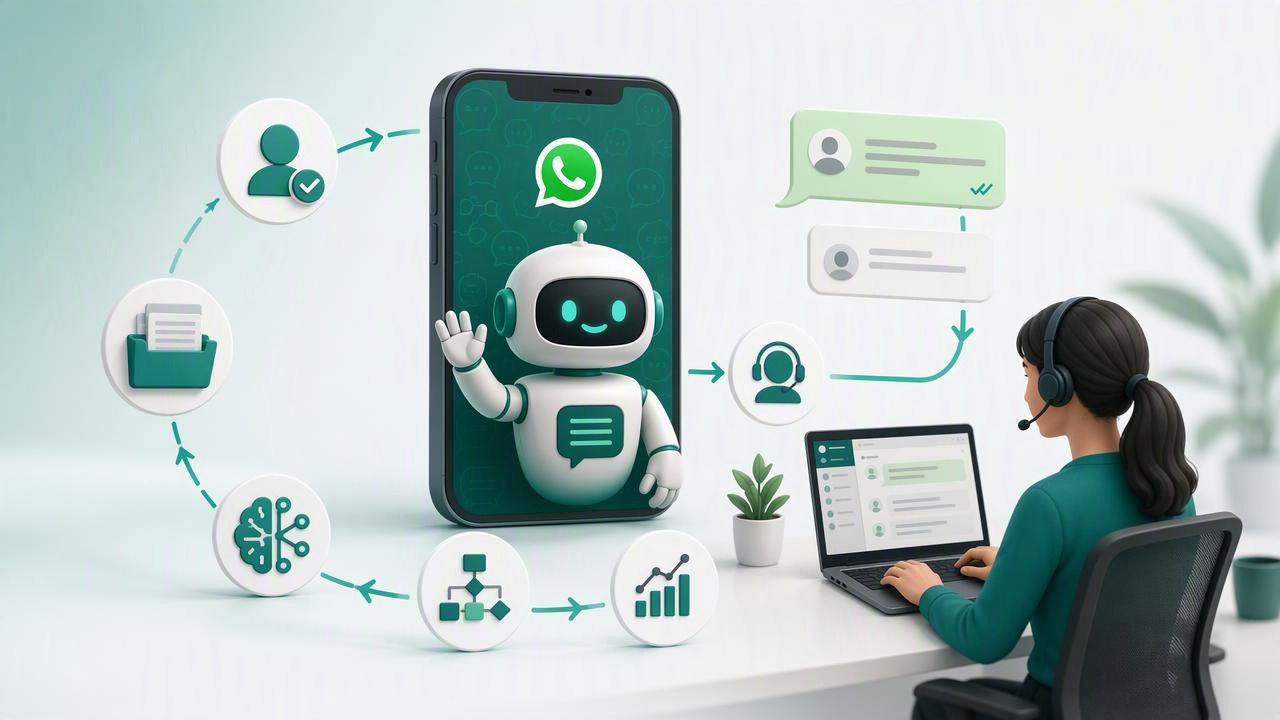
Agencies are increasingly asked to deploy WhatsApp AI agents for lead qualification, customer support, appointment booking, and frequently asked questions. The opportunity is significant, but so is the operational risk. A successful pilot for one client can quickly become a difficult-to-manage collection of custom prompts, scattered PDFs, disconnected inboxes, and manual reporting.
The answer is not simply adding more automation. To learn how to get repeatable agency delivery with WhatsApp AI agent platform workflows, agencies need a standardized operating model: reusable implementation steps, clear client boundaries, controlled knowledge sources, reliable human handoff, and measurable outcomes.
This guide explains how to turn individual WhatsApp AI projects into a scalable, repeatable service without treating every client deployment as a one-off build.
Why WhatsApp AI Agent Delivery Becomes Hard to Scale
WhatsApp is a high-intent channel. Prospects often expect quick answers, existing customers expect context, and a delayed reply can mean a lost sale. An AI agent can help teams respond around the clock, but agencies still need to manage different brands, business rules, data sources, users, and escalation processes.
Delivery becomes inconsistent when each client has a different approach to basic operational questions:
- Where does the agent get approved answers?
- Which questions should it answer versus escalate?
- Who can view customer conversations and change instructions?
- How are leads tagged, qualified, and routed?
- What happens when the AI is uncertain or a customer asks for a person?
- How does the agency prove business value each month?
A repeatable system does not mean every client receives an identical agent. It means the delivery framework is consistent while the client-specific knowledge, voice, business logic, and routing rules remain configurable.
Start With a Productized Service Blueprint
Before onboarding clients, define a clear service package. Productization helps your sales team set accurate expectations and helps your implementation team avoid scope creep. Rather than selling “an AI chatbot,” describe the business outcome and the included operating components.
For example, a foundational package might include one WhatsApp agent, an approved knowledge base, lead qualification questions, one human handoff workflow, conversation monitoring, and a monthly performance review. Advanced packages can add multilingual support, CRM integrations, more complex routing, analytics, or additional business locations.
Standardize the client intake questionnaire
A structured intake process should capture the information needed to configure an agent correctly. Ask clients for:
- Primary customer goals, such as booking consultations or answering product questions.
- Business hours, service areas, pricing rules, and policies.
- Top customer questions and ideal approved answers.
- Lead qualification criteria and disqualifying conditions.
- Escalation contacts, teams, and expected response times.
- Brand tone, prohibited statements, and regulatory requirements.
- Current PDFs, webpages, catalogs, price lists, and internal documents.
Use the same intake form for every engagement. This creates a reliable handoff from sales to implementation and reduces the chance that essential client information lives only in someone’s inbox or memory.
Build a Reusable Agent Configuration Framework
The core of repeatable delivery is separating reusable agent rules from client-specific content. Your agency should maintain a base configuration that establishes universal safety, communication, and escalation behavior. Then create a separate layer for each client’s brand and operations.
| Configuration layer | What it includes | How often it changes |
|---|---|---|
| Agency baseline | Safety rules, uncertainty behavior, human handoff logic, formatting standards | Rarely |
| Client profile | Brand voice, audience, services, locations, operating hours | Occasionally |
| Knowledge base | Approved PDFs, FAQs, catalogs, policy documents, source links | Regularly |
| Conversation workflow | Qualification questions, tags, routing, follow-up actions | As business processes evolve |
For example, the baseline instruction can require the agent to avoid inventing pricing, ask a clarifying question when information is missing, and offer a human handoff for complaints or sensitive cases. The client profile can then specify whether the brand should sound concise and formal or warm and conversational.
A simple prompt structure may look like this:
Role: You are the WhatsApp assistant for [Client Name].
Goal: Help customers with approved information and qualify relevant leads.
Rules:
- Use only approved knowledge when answering factual questions.
- Do not guess about prices, availability, or policy exceptions.
- Ask at most one qualification question at a time.
- Offer human support when the customer asks, is frustrated, or needs an exception.
- Summarize the conversation before handing it off.
This approach makes quality control much easier. Instead of rewriting agent behavior from scratch, your team applies a tested baseline and configures the variables that make the deployment specific to the client.
Make Client Knowledge Bases Governed, Not Just Uploaded
A knowledge base is not a folder of documents. It is the controlled source of information the AI agent is allowed to use when answering customers. Weak knowledge governance is one of the main reasons agents provide outdated, incomplete, or inconsistent answers.
Create a repeatable knowledge-base process with defined ownership. During onboarding, collect source materials, remove duplicates, identify outdated documents, and label each source by topic and effective date. Ask the client to approve the final set before launch.
Use a knowledge review checklist
- Confirm that each file belongs to the correct client workspace.
- Check that prices, promotions, contact details, and operating hours are current.
- Remove conflicting versions of policies or catalogs.
- Identify questions that documents do not answer clearly.
- Create approved FAQ entries for high-volume questions.
- Assign a client-side owner for future updates.
For multi-client agency operations, tenant isolation is essential. One client’s documents, conversations, instructions, and users should never be visible to another client. Strong permissions and workspace boundaries protect confidential business information while also preventing accidental cross-client errors.
Design Human Handoff as a Core Feature
Human handoff is not evidence that the AI failed. It is a necessary part of a trustworthy service. A WhatsApp AI agent should handle repetitive, well-defined interactions while giving people control over complex, emotional, high-value, or exceptional situations.
Define escalation triggers before launch. Common triggers include:
- A customer explicitly asks to speak with a human.
- The agent cannot find an answer in approved sources.
- The conversation involves a complaint, refund, legal issue, or payment dispute.
- A high-value lead meets defined qualification criteria.
- The customer expresses frustration or repeats the same question.
A useful handoff should provide the receiving team with context, not just an alert. Include a concise conversation summary, customer intent, captured contact details, qualification answers, and the recommended next action. This reduces response time and prevents customers from repeating themselves.
The best AI agent experiences make escalation feel seamless: automation handles the routine work, while people take over when judgment and empathy matter most.
Create a Consistent Launch and Quality Assurance Process
Launching directly into live customer conversations without testing is avoidable risk. Build a quality assurance checklist that every deployment must pass. Assign ownership for each stage so no critical review is skipped during a busy onboarding period.
Pre-launch testing scenarios
- Ask common FAQs using natural, incomplete, and misspelled messages.
- Test questions the agent should not answer.
- Verify lead qualification questions appear in the right order.
- Confirm human handoff reaches the intended inbox or team.
- Test after-hours behavior and response expectations.
- Check multilingual responses if that service is included.
- Verify that each workspace uses only its own knowledge and settings.
Run these tests with realistic WhatsApp-style messages, not only polished scripts. Customers use voice-note summaries, abbreviations, partial questions, emojis, and changing topics. Your QA process should reflect real conversation behavior.
Use Metrics That Connect AI Activity to Client Value
Recurring revenue depends on demonstrating ongoing value. Counting conversations alone is rarely enough. Build a monthly reporting template that shows both operational performance and commercial impact.
Useful metrics include first-response time, conversations handled, automated resolution rate, handoff rate, qualified leads, booked appointments, unanswered-question themes, and estimated staff time saved. Segment results by intent where possible. A client will care more about qualified quote requests than a generic count of messages.
Also review qualitative data. Repeated questions may indicate a missing knowledge-base article. A high handoff rate can signal that the agent needs better instructions, or it may reveal that human expertise is genuinely necessary for that workflow. The goal is not to eliminate handoff; it is to make the automation-to-human balance intentional.
Operationalize Ongoing Optimization
Repeatable delivery requires a recurring improvement rhythm. Schedule a monthly or quarterly review with the client, depending on message volume and service level. Review the top conversation intents, missed answers, lead quality, handoff outcomes, and upcoming changes to services or policies.
Maintain a change log for every client. Record what changed, who approved it, why it changed, and what outcome you expect. This supports accountability and makes troubleshooting much easier when multiple agency team members manage the account.
As your portfolio grows, create internal playbooks for common verticals such as clinics, real estate, education, retail, or professional services. Each playbook can include typical FAQs, qualification flows, risk areas, sample handoff rules, and recommended KPIs. This lets the agency move faster while preserving the ability to customize responsibly.
Choose Platform Capabilities That Support Repeatability
A scalable WhatsApp AI agent platform should support client isolation, role-based access, separate knowledge bases, conversation visibility, configurable handoff, and dependable integrations. Agencies may also need white-label access, OpenAI-compatible model options, self-hosted deployment controls, or a managed cloud environment depending on their clients’ requirements.
Evaluate platforms based on the work your team must repeat every week: onboarding, configuring agents, reviewing conversations, updating knowledge, routing leads, managing permissions, and reporting outcomes. A platform that reduces friction in those workflows is more valuable than one with a long list of features that do not match your operating model.
For agencies that want an open-source option for isolated, branded WhatsApp agent operations, OpenLivery is one example to assess alongside your security, deployment, and workflow requirements.
Turn Delivery Into a System, Not a Heroic Effort
Repeatable agency delivery comes from disciplined design. Standardize intake, build reusable agent rules, govern knowledge, protect client boundaries, plan human handoff, test thoroughly, and report on meaningful outcomes. With these foundations in place, your agency can deliver WhatsApp AI agents consistently while still adapting each implementation to the client’s business.
The result is a service that is easier to sell, easier to manage, safer to scale, and more likely to create long-term value for both the agency and its clients.
