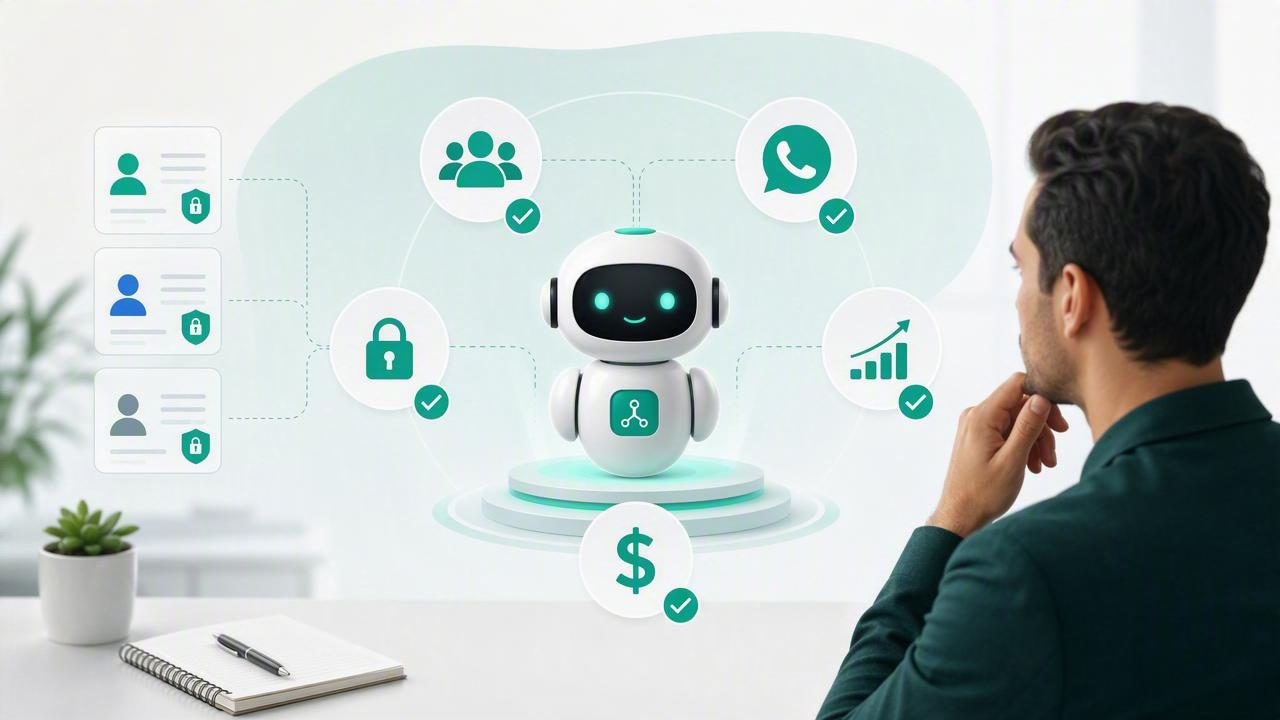
Agencies are increasingly asked to deliver more than websites, campaigns, and lead generation. Clients now expect fast, always-on communication across channels they already use, especially WhatsApp. That demand has created a major opportunity for agencies to package AI-powered support, lead qualification, booking, and customer engagement as a managed service.
But not every AI tool is built for an agency model. A single-business chatbot may work well for one internal team, yet become difficult to manage when an agency needs to serve ten, fifty, or hundreds of separate clients. Choosing the right white label AI agent platform for agencies requires evaluating operational controls, client separation, branding, integrations, security, and the ability to involve humans at the right moment.
This guide explains what agencies should look for, how to compare platform options, and how to build a scalable AI agent offering without creating unnecessary technical or delivery risk.
What Is a White Label AI Agent Platform?
A white label AI agent platform enables an agency to deploy conversational AI agents under its own brand or under each client’s brand. Rather than sending clients to a generic software vendor interface, the agency can create branded experiences, configure client-specific knowledge, and manage multiple accounts from one operational environment.
AI agents go beyond a basic scripted chatbot. They can use language models to understand customer questions, retrieve relevant information from approved documents or systems, collect lead details, and route complex situations to a human team member.
For example, a property agency could deploy separate WhatsApp agents for:
- A real estate brokerage answering listing and viewing questions
- A dental clinic handling appointment-related enquiries
- A home services company qualifying repair requests
- An e-commerce retailer answering delivery and returns questions
Each client needs its own instructions, source content, tone of voice, inboxes, users, and reporting. The agency needs a consistent way to configure, monitor, improve, and bill for all of them.
Why Agencies Need Multi-Client Architecture
The biggest difference between an agency-ready platform and a standard AI chatbot tool is tenant isolation. In a multi-client environment, each client should operate as an independent workspace with separate agents, data sources, conversations, credentials, and permissions.
Without strong isolation, agencies can face serious issues: a team member may accidentally edit the wrong client’s instructions, a knowledge source may become available to another account, or reporting may mix conversations from different brands. These are not merely workflow inconveniences. They can create confidentiality, compliance, and reputational risks.
When reviewing a platform, ask how it separates the following:
- Knowledge bases: PDFs, FAQs, web content, policies, product catalogues, and internal documents must be scoped to the correct client.
- Conversations: Customer messages and contact details should never appear in another client’s inbox or analytics.
- Model settings: Prompts, model choices, guardrails, and response rules should be configurable per client.
- Users and roles: Agency administrators, client managers, and frontline staff need different access levels.
- Integrations: WhatsApp numbers, CRMs, calendars, and API credentials should be assigned safely to each tenant.
A scalable AI service is not just about generating good answers. It is about delivering the right answer from the right data, in the right client environment, with the right people able to intervene.
Essential Features to Evaluate
1. Branded Client Experiences
White labeling can mean different things. At a minimum, agencies should be able to present an AI agent as a client-owned assistant with a client-specific name, personality, language, and knowledge. More advanced platforms may also allow custom domains, branded portals, configurable notifications, and agency-level branding.
Branding matters because customers are more likely to trust an assistant that reflects the business they contacted. It also helps an agency position AI automation as part of its strategic service, rather than as an unfamiliar third-party product.
2. WhatsApp and Channel Readiness
WhatsApp AI agents are especially valuable for businesses that generate enquiries through social media, ads, local search, or referrals. Customers can message from their phone without downloading another app or filling out a long form.
However, channel support should be evaluated beyond a simple connection. Check whether the platform supports conversation history, media handling, business-approved message templates where needed, lead capture, team visibility, and reliable human takeover. Also confirm how the system handles messages outside working hours and how it avoids sending an automated reply after a human has taken control.
3. Client Knowledge Bases
An agent is only as useful as the information it can reliably access. Look for a platform that can ingest common business materials, including PDFs, policy documents, service menus, product information, and frequently asked questions. It should be easy to update this knowledge without rebuilding the entire agent.
Good knowledge-base workflows include source management, document replacement, content review, and testing. Agencies should also be able to instruct agents to say when they do not know an answer instead of inventing one. This is especially important for regulated, medical, financial, legal, or high-consideration services.
4. Human Handoff
Automation should improve customer service, not trap customers in an endless bot loop. Human handoff is essential when a customer requests a person, expresses frustration, asks a sensitive question, or reaches a high-value buying stage.
Effective handoff includes clear escalation triggers, a shared conversation inbox, agent context for the human responder, and a way to pause or resume automation. The customer should not need to repeat their question after the transfer.
A practical escalation rule could look like this:
Escalate to a human when:
- The customer explicitly asks for an agent or staff member
- The confidence in the answer is low
- The issue involves a complaint, payment, or sensitive data
- The lead requests a quote, booking, or urgent assistance
Security, Permissions, and Data Control
AI agent security should be a core buying criterion, particularly when agencies handle customer conversations on behalf of multiple businesses. The platform should provide role-based permissions so that agency owners, account managers, client administrators, and support staff only access what they need.
Review how the vendor handles authentication, data storage, auditability, backups, and API credentials. If a client needs tighter control over data residency or infrastructure, self-hosted AI software may be more suitable than a cloud-only product.
Open-source software can be attractive here because it gives agencies the ability to inspect the code, adapt workflows, and deploy within their preferred environment. However, self-hosting also creates responsibilities for security patches, database operations, monitoring, backups, and uptime. Agencies should weigh those obligations against the convenience of a managed AI agent cloud.
Managed Cloud vs. Self-Hosted Deployment
| Consideration | Managed Cloud | Self-Hosted Deployment |
|---|---|---|
| Setup speed | Usually faster | Requires infrastructure setup |
| Maintenance | Vendor manages updates and operations | Agency or technical partner manages operations |
| Control | Configuration-level control | Greater infrastructure and code control |
| Security responsibility | Shared with provider | Primarily owned by the deploying organization |
| Best fit | Agencies prioritizing speed and simplicity | Clients with custom, compliance, or hosting needs |
There is no universal answer. A managed option may be ideal for launching a repeatable service quickly, while self-hosting can support enterprise accounts that require deeper control. The best platform gives an agency a realistic deployment path for both types of clients.
Model Flexibility and AI Quality
Agencies should avoid building a service that depends entirely on one model provider. Platforms that support OpenAI-compatible models can offer more flexibility in cost, performance, privacy, and regional availability. This does not mean every client needs a different model. It means the agency has options as requirements evolve.
Evaluate how easily you can set instructions, choose a model, tune response length, define safety boundaries, and test agent behavior. An agent for lead qualification may need concise, structured questions, while an agent for customer support may need more detailed retrieval from a knowledge base.
Before launching, test realistic customer messages, including misspellings, ambiguous requests, pricing questions, angry messages, unsupported topics, and requests for a human. This testing should be part of every client onboarding process, not a one-time task.
Building Recurring Revenue Around AI Agents
A white label AI agent platform can support recurring revenue when agencies productize the service instead of treating every implementation as a custom project. Create clear packages based on outcomes and operational scope.
- Starter: One channel, one knowledge base, basic lead capture, and monthly reporting.
- Growth: Multiple workflows, human handoff, CRM integration, ongoing knowledge updates, and optimization.
- Enterprise: Multiple brands or locations, self-hosted deployment options, advanced permissions, custom integrations, and service-level support.
Include an onboarding fee for discovery, knowledge preparation, agent design, testing, and launch. Then charge a monthly fee for platform access, monitoring, improvements, reporting, and support. This model aligns agency revenue with the ongoing value of maintaining a helpful and accurate AI agent.
A Practical Platform Evaluation Checklist
- Can every client have isolated agents, knowledge, conversations, and users?
- Does the platform support the channels your clients actually use, including WhatsApp?
- Can you create clear human handoff rules and manage live conversations?
- Are client knowledge bases easy to upload, update, test, and govern?
- Does the platform offer role-based permissions and appropriate security controls?
- Can you use OpenAI-compatible models or adapt model choices over time?
- Is there a managed cloud option, self-hosting option, or both?
- Can your team repeat onboarding and reporting across many client accounts?
- Can you package the service into profitable recurring revenue tiers?
Final Thoughts
The right white label AI agent platform for agencies should make growth more manageable, not add a separate technical project for every new customer. Prioritize multi-client isolation, branded agent experiences, reliable WhatsApp workflows, governed knowledge bases, human handoff, and security controls. Then choose a deployment model that matches your agency’s skills and your clients’ requirements.
For agencies exploring an open-source approach with managed or self-hosted deployment options, OpenLivery is one example of a platform designed around isolated client agents, knowledge, and conversations.
