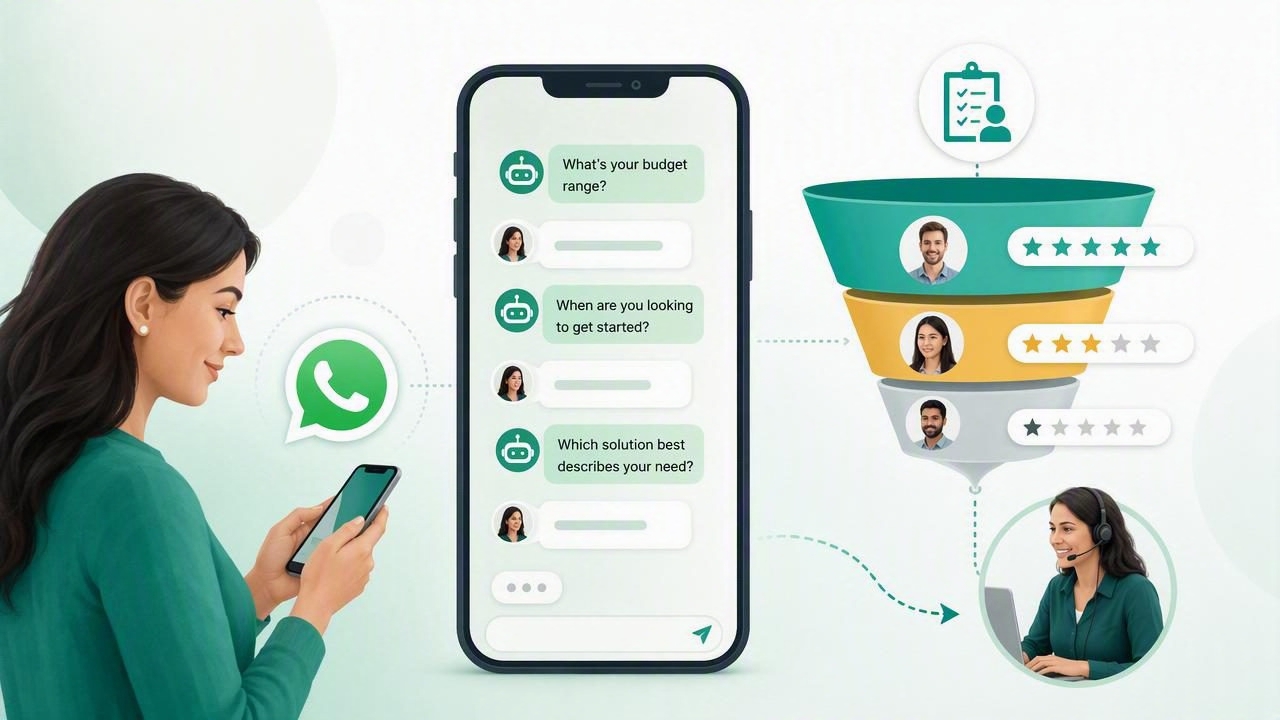
WhatsApp is one of the fastest ways for prospects to start a conversation with a business. A visitor may click a website button, respond to an ad, or message after receiving a referral—and expect a useful response within minutes. That speed creates an opportunity, but it also creates a challenge: not every inquiry is ready for sales.
Learning how to qualify leads on WhatsApp helps teams identify high-intent prospects, route conversations to the right person, and avoid wasting sales time on inquiries that are not a fit. The goal is not to interrogate every contact. It is to gather the minimum information needed to understand fit, urgency, and next steps while keeping the interaction natural.
This guide explains a practical WhatsApp lead qualification workflow, including the questions to ask, how to score leads, where automation helps, and when a human should take over.
What Is WhatsApp Lead Qualification?
Lead qualification is the process of determining whether a prospective customer is likely to buy and whether your business can solve their problem. On WhatsApp, this usually happens through a short, conversational exchange rather than a long form or scheduled discovery call.
A qualified lead typically has some combination of the following:
- A clear business or personal need your product or service can address.
- Decision-making authority or access to the person who has it.
- A realistic budget, project scope, or willingness to discuss pricing.
- A timeline that makes a sales conversation worthwhile.
- Location, industry, technical requirements, or other criteria that match your ideal customer profile.
The exact criteria differ by business. A local service company may prioritize postal code, service type, and appointment availability. A B2B agency may care more about company size, monthly budget, current tools, and campaign deadlines.
Why WhatsApp Is Effective for Lead Qualification
Traditional lead forms can produce incomplete data and delayed follow-up. Email responses can take days. WhatsApp reduces that delay because the channel feels immediate, personal, and familiar to many buyers.
When used well, WhatsApp qualification can help businesses:
- Respond faster: Answer common questions immediately and engage prospects while intent is high.
- Reduce friction: Ask one simple question at a time instead of presenting a long form.
- Collect better context: Let leads explain their needs in their own words, including voice notes or images where appropriate.
- Prioritize sales effort: Send high-value opportunities to sales while offering useful next steps to lower-intent contacts.
- Create a consistent process: Ensure every inbound inquiry receives the same core qualification experience.
However, speed should not become pressure. A good WhatsApp conversation earns trust first, then asks relevant questions. Prospects should always understand why you are requesting information and what will happen next.
Build Your Qualification Framework Before Writing Messages
Before setting up replies or automation, define what a good lead looks like. A simple framework prevents teams from collecting data they never use.
Start with your ideal customer profile
Your ideal customer profile (ICP) describes the type of buyer most likely to benefit from your offer. Consider company size, industry, geography, service needs, job role, existing technology, and typical budget. For consumer businesses, use practical factors such as service area, product preference, purchase timing, or eligibility.
Choose four to six essential qualification fields
Do not ask for everything at once. Pick the fields that directly affect routing or conversion. For example, a B2B marketing agency might collect:
- Company name and industry
- Main goal or challenge
- Current monthly marketing investment
- Target launch date or urgency
- Role in the buying decision
A home services business might instead ask for the type of service required, property location, preferred appointment time, and a brief issue description.
How to Qualify Leads on WhatsApp Step by Step
1. Open with a fast, helpful welcome
The first message should acknowledge the inquiry, state how you can help, and ask one easy question. Avoid a generic “How can we help?” when you already know the source of the conversation.
Hi Sarah, thanks for contacting us about paid social campaigns.
I can help point you in the right direction. What is your main goal right now: more leads, more sales, or improving return on ad spend?
This opening confirms the context and gives the prospect a low-effort way to respond. Multiple-choice prompts can improve completion, but always leave room for a free-text answer.
2. Discover the problem before discussing the solution
Needs-based questions reveal whether there is a meaningful opportunity. They also make later recommendations more relevant. Ask questions such as:
- “What are you hoping to improve?”
- “What have you tried so far?”
- “What is the biggest obstacle preventing you from reaching that goal?”
- “What would a successful outcome look like for you?”
Use the answer to summarize what you heard. For example: “Understood—you want to increase qualified demo requests without increasing your cost per lead.” This confirms accuracy and makes the conversation feel attentive rather than automated.
3. Confirm fit with focused questions
Once the need is clear, collect the facts that determine fit. Explain the reason when a question may feel sensitive. Instead of bluntly asking, “What is your budget?” try:
To recommend the right option, could you share the approximate monthly budget range you have in mind?For B2B sales, a practical sequence is need, company context, budget range, timeline, and decision process. For higher-ticket services, asking about urgency early can also help prioritize leads that need immediate support.
4. Use lead scoring to make routing consistent
Lead scoring converts conversational information into a repeatable decision. You do not need a complicated predictive model to start. Assign points based on your most important buying signals.
| Qualification signal | Example | Points |
|---|---|---|
| Strong need | Clear problem your offer solves | 25 |
| Ideal customer fit | Right industry, location, or company size | 20 |
| Budget alignment | Budget matches the service range | 20 |
| Near-term timeline | Ready to start within 30 days | 20 |
| Decision access | Decision-maker or direct stakeholder involved | 15 |
A score of 70 or above may trigger a sales handoff, while a mid-range score could trigger a follow-up sequence or an invitation to book a consultation. Low scores are not necessarily bad leads; they may simply need educational content, a future reminder, or a different offer.
5. Offer a clear next step
Every qualification path should end with an action. For high-intent prospects, offer a live conversation, calendar link, quote process, or handoff to a specialist. For example:
Based on what you shared, this looks like a strong fit. Would you like me to connect you with a strategist today, or would you prefer to book a 20-minute call?For leads who are not ready, provide value without forcing a sales call. Send a relevant guide, explain a starting package, or ask permission to follow up closer to their target date.
Where AI Automation Helps—and Where It Does Not
AI agents can handle the repetitive parts of WhatsApp lead qualification: greeting contacts, answering frequently asked questions, collecting structured details, summarizing conversations, and applying an initial score. When connected to an accurate knowledge base, an agent can explain services, eligibility requirements, locations, or pricing guidance consistently.
Automation works best when it has defined boundaries. It should not invent pricing, promise outcomes, provide legal or financial advice, or continue a frustrating conversation when the prospect asks for a person. Configure a clear human handoff for cases involving complex requirements, complaints, sensitive data, high-value deals, or explicit requests for support.
Best practice: Let automation gather context and reduce response time, but let trained people handle nuance, negotiation, and relationship-building.
Protect Privacy and Maintain Trust
WhatsApp is a personal channel, so trust matters. Collect only the information necessary for qualification. Tell contacts why you need sensitive details, avoid requesting confidential information in chat, and ensure access to conversations is limited to authorized team members.
Businesses should also keep source records, consent status, lead ownership, and conversation history organized. For agencies managing several clients, tenant separation is especially important: one client’s leads, documents, and team permissions should never be visible to another client.
Common WhatsApp Lead Qualification Mistakes
- Asking too many questions at once: Break the exchange into short, logical steps.
- Using generic scripts: Tailor prompts to the ad, landing page, referral, or service that started the conversation.
- Ignoring unstructured answers: Prospects may provide valuable context that does not fit a button or form field.
- Failing to define handoff rules: Sales teams need clear criteria for when they should enter the chat.
- Not measuring outcomes: Track qualified-lead rate, response time, booking rate, sales acceptance, and conversion to revenue.
Turn Conversations Into a Repeatable Revenue Process
The best answer to how to qualify leads on WhatsApp is not a single script. It is a disciplined workflow: respond quickly, understand the need, confirm fit, score consistently, and move the conversation to the right next step.
Review conversations regularly to find questions that create drop-off, common objections, and signs that predict closed deals. Then refine your scripts, knowledge base, scoring rules, and handoff process. Agencies that need isolated client knowledge and branded WhatsApp workflows can also explore open-source platforms such as OpenLivery to support a scalable, permission-aware operating model.
