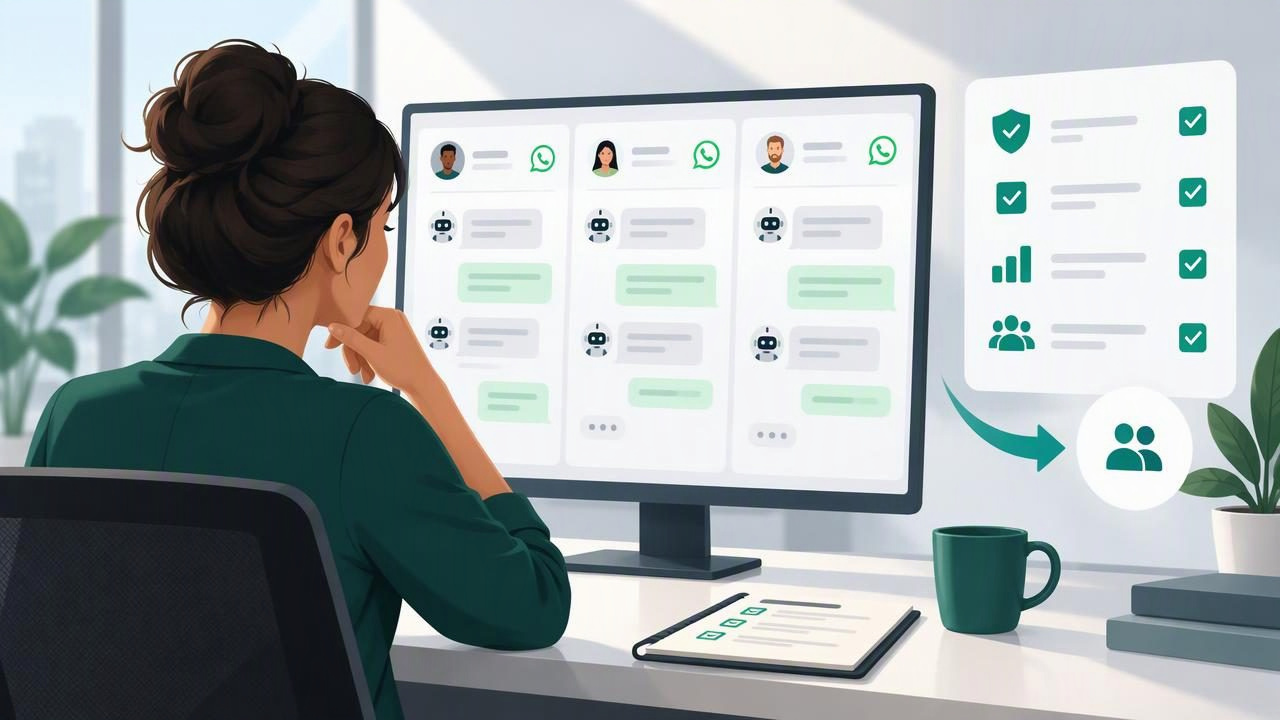
Reviewing AI conversations is a core part of delivering a reliable service—not just a quality-control task. For agencies managing WhatsApp AI agents for multiple clients, regular reviews can reveal unanswered questions, confusing replies, weak lead qualification, and handoff delays. They can also expose a serious operational risk: seeing or sharing information from the wrong client account.
A repeatable process helps agency teams improve agent performance without blurring client boundaries. This guide provides a practical review conversations across client accounts checklist for agencies using an open-source AI agent platform. It covers access, sampling, conversation quality, knowledge gaps, human handoff, and follow-up actions.
Why review conversations across client accounts?
Each client’s agent has a different audience, tone, knowledge base, and definition of a useful outcome. A property agency may need to qualify buyers and arrange viewings, while a clinic may need to answer approved service questions and route sensitive requests to staff. One generic quality score cannot capture these differences.
At the same time, agency teams need a consistent way to spot patterns across their portfolio. A shared review framework makes it easier to identify recurring technical issues, compare delivery quality, and improve onboarding. The goal is not to make every client’s agent behave identically. It is to apply common standards for accuracy, safety, privacy, and operational follow-through.
Start with access and account boundaries
Before opening a conversation, confirm that the reviewer is authorized to access that client’s workspace. In a multi-client agency operation, separation should apply to conversations, uploaded documents, agent settings, and review exports—not just the visible client name. The platform’s permissions should support least-privilege access, so team members see only the accounts and functions needed for their work.
Use individual logins, assign access by role, and remove permissions when someone changes responsibilities or leaves the team. Avoid shared accounts and informal workarounds such as copying client conversations into a general-purpose document. When a review needs collaboration, use an approved process that preserves the account context and limits exposure of personal information.
Review conversations across client accounts: checklist
Use this checklist for scheduled quality reviews, escalations, and post-launch audits. Record findings in the relevant client workspace so recommendations do not become detached from the agent, knowledge base, or business process they concern.
- Confirm the account and reviewer. Check the client workspace, reviewer permissions, and review purpose before inspecting messages. Verify that any export or screenshot will remain in an approved location.
- Choose a useful sample. Include routine questions, conversations with unclear intent, failed answers, lead qualification, and human handoffs. Review a balanced mix of recent conversations rather than selecting only obvious failures.
- Check the customer’s goal. Did the agent identify what the person wanted? Did it ask a relevant follow-up question, or did it force the customer through an unnecessary script?
- Verify factual accuracy. Compare important claims with the client’s approved knowledge sources. Check prices, availability, policies, opening hours, service areas, and any time-sensitive details.
- Inspect grounding and uncertainty. Look for confident claims that are missing from the client’s documents. A helpful agent should say when it cannot verify an answer and offer a safe next step instead of guessing.
- Assess tone and brand fit. Consider whether the response is clear, respectful, and appropriate for that client. Brand voice matters, but it should never take priority over accuracy or a customer’s need for a direct answer.
- Review qualification quality. If the agent collects lead details, check that each question is necessary, understandable, and asked at the right point in the conversation. Confirm that the resulting lead information is useful to the client’s team.
- Evaluate human handoff. When the agent cannot safely or effectively continue, did it route the conversation to the right person? Check whether the customer understood what would happen next and whether staff received enough context.
- Check privacy and permissions. Look for unnecessary collection or repetition of personal details, accidental disclosure, and any sign of cross-client information appearing in a response. Escalate suspected exposure immediately using the incident process.
- Log an action, owner, and due date. A review is incomplete until someone is responsible for the next step. Note whether the fix belongs in the prompt, client knowledge base, integration, workflow, or human support process.
Use a consistent scorecard, not a vague impression
A lightweight scorecard helps reviewers explain why a conversation passed or failed. Score each category using a simple scale, such as 1 for needs attention, 2 for acceptable with a gap, and 3 for meets the standard. Add a short evidence note rather than relying on a score alone.
| Review area | What to look for | When to escalate |
|---|---|---|
| Accuracy | Answers match approved client information | Unsupported or potentially harmful claim |
| Conversation quality | Clear, relevant, and responsive messages | Repeated confusion or abandoned flow |
| Handoff | Correct route and useful staff context | Urgent request not routed appropriately |
| Privacy | Only necessary information is handled | Possible disclosure or account mix-up |
| Outcome | Customer gets an answer or clear next step | Lead or support request is lost |
Set client-specific expectations alongside shared agency standards. For example, one client may prefer a short answer followed by a booking link, while another may require a staff member to confirm eligibility. Document these differences so reviewers do not mistake a deliberate workflow for a defect.
Make sampling practical for a busy agency
Reviewing every message is rarely realistic, particularly as the number of client accounts grows. Use risk-based sampling: inspect more conversations after a new launch, a knowledge-base update, a model change, or an incident. Continue routine sampling for stable agents, and include all high-impact handoffs or reported failures when possible.
A simple cadence might include a small weekly sample for active or recently changed agents, a monthly review for stable accounts, and an immediate review after a serious complaint or suspected safety issue. The right frequency depends on conversation volume, business risk, and the client’s service expectations. Agree on the cadence with each client and record it in the account’s operating notes.
Turn findings into controlled improvements
Tag findings by cause, not merely by outcome. Useful categories include missing source information, ambiguous instructions, unsupported model response, poor intent recognition, integration failure, and handoff delay. This makes it easier to identify a recurring root cause across accounts without mixing their private conversation data.
Then choose the smallest effective change. If the correct answer is absent from the client’s PDFs, update that client’s knowledge base and verify the new source. If the source is accurate but the agent ignores it, review retrieval settings or instructions. If a human received no useful summary, improve the handoff workflow. Test the change with representative conversations before considering it resolved.
Open-source AI agent platforms can make it easier for agencies to inspect and adapt their operating processes, especially when self-hosting is important. However, open source does not automatically guarantee secure isolation. Review the actual permission model, deployment configuration, logging, backups, and data-retention practices. When using OpenAI-compatible models, also document which provider processes conversation data and under what settings.
Common review mistakes to avoid
- Copying records between clients: Cross-account spreadsheets and chat threads can create accidental exposure. Keep notes in the correct client context and minimize copied personal data.
- Changing live behavior without testing: A quick prompt edit may solve one example but break another. Test normal, edge-case, and handoff scenarios before deployment.
- Scoring only the AI reply: The customer experience also depends on WhatsApp delivery, integrations, staff response time, and the clarity of the next step.
- Treating every failure as a model problem: Missing documents, stale client policies, and broken workflows often need operational fixes rather than a different model.
- Collecting more data than needed: Reviews should help improve service. Avoid retaining unnecessary personal details in review notes or reports.
Build a review loop clients can trust
Share useful trends with each client in a concise report: what is working, what customers are asking, where the agent is uncertain, and which improvements are underway. Separate client-specific findings from anonymized agency-wide patterns. If you share benchmarks across accounts, remove details that could identify a client or reveal their conversations.
Track operational measures such as the proportion of sampled conversations with accurate answers, the rate of appropriate handoffs, recurring knowledge gaps, and time to resolve identified issues. Treat these as signals for investigation, not as standalone proof of success. A lower handoff rate, for example, is not necessarily positive if customers who need staff are being left without help.
A disciplined review process lets agencies improve WhatsApp AI agents while respecting each client’s data, goals, and permissions. The best checklist is one reviewers can follow consistently, with clear escalation routes and accountable owners for every fix. Teams evaluating tools for this workflow can compare deployment options, account isolation, and review controls; OpenLivery is one open-source platform agencies may consider as part of that evaluation.
