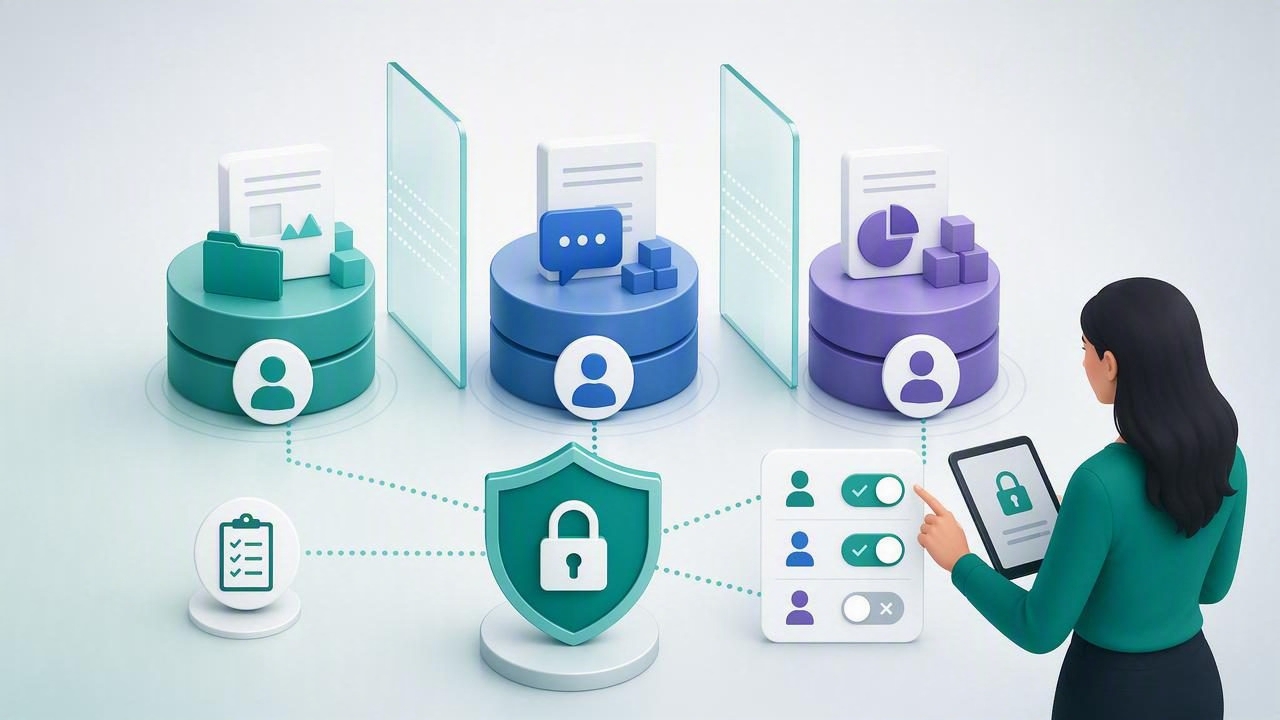
Agencies deploying AI agents for multiple businesses face a critical operational responsibility: ensuring that one client’s data can never appear in another client’s conversations. This requirement becomes especially important when agencies use client knowledge bases to power WhatsApp AI agents, lead qualification workflows, support assistants, and human handoff processes.
A knowledge base may contain product catalogs, pricing documents, internal procedures, FAQs, sales scripts, contracts, PDFs, and customer service policies. If these materials are improperly organized or retrieved, an AI agent could provide inaccurate answers at best—or expose confidential client information at worst.
This guide explains how to get stronger client data separation with a client knowledge base. It covers the architecture, permissions, retrieval controls, operational practices, and testing methods agencies need to deliver secure AI agent services at scale.
Why Client Data Separation Matters for AI Agencies
Traditional agency work often involves separate folders, separate accounts, and separate client contacts. AI agent operations introduce a new challenge: a single platform may process many conversations and search many knowledge sources in real time.
Without strong tenant isolation, an agent serving Client A could theoretically retrieve a document uploaded for Client B. Even if the agent does not expose raw files, a retrieval error could lead it to mention another company’s price, policy, process, or product detail.
Strong client data separation protects more than confidentiality. It also improves answer quality, simplifies agency operations, and creates a more trustworthy white-label experience.
- Privacy: Client-owned documents, conversations, and contacts remain private.
- Accuracy: Agents answer from the correct brand’s approved information.
- Compliance: Agencies can better meet contractual, privacy, and security expectations.
- Brand integrity: Each agent follows its own client’s voice, policies, and commercial rules.
- Scalability: Teams can add clients without creating an unmanageable set of manual safeguards.
Start With a True Tenant Isolation Model
The strongest approach is to treat every client as a separate tenant. A tenant is a logical security boundary that groups all resources belonging to one client: agents, users, conversations, channels, documents, vector records, integrations, and audit logs.
Tenant isolation should not be merely a naming convention such as adding a client name to document titles. It must be enforced in the application architecture and database queries. Every important record should be associated with a tenant identifier, and every read or write should verify that identifier.
Resources That Should Be Tenant-Scoped
- Knowledge base documents and file uploads
- Document chunks and vector embeddings
- AI agents, prompts, and configured tools
- WhatsApp numbers, inboxes, and message history
- Leads, customer contact records, and qualification fields
- Human handoff queues and assigned team members
- API keys, webhooks, and third-party connections
- Usage records, billing data, and audit events
For example, a document chunk should never exist as an unscoped record that can be searched globally. It should include a client or tenant ID from ingestion through retrieval.
{
  "tenant_id": "client_acme",
  "document_id": "pricing-guide-2026",
  "chunk_id": "pricing-guide-2026-12",
  "content": "Acme installation packages start at...",
  "metadata": {
    "source": "Acme Pricing PDF",
    "access_level": "standard"
  }
}
The agent request should carry the same tenant context. The retrieval layer then filters records before similarity search results are returned.
Isolate Retrieval, Not Just File Storage
Many teams focus on where PDFs are stored. Secure storage is important, but it is only one part of the problem. A modern client knowledge base typically converts files into smaller chunks, creates embeddings, and stores those embeddings in a vector database for semantic search.
The retrieval layer is where cross-client leakage can occur if filters are missing, optional, or applied after a broad search. The correct design is to apply the tenant filter as part of the retrieval query itself.
Use Mandatory Metadata Filters
Every retrieval query should include a non-negotiable tenant condition. Do not let an AI model decide which tenant to search. The application should determine the client context from the authenticated user, connected WhatsApp number, or assigned agent configuration.
searchKnowledgeBase({
  query: customerMessage,
  filters: {
    tenant_id: activeTenantId,
    status: "published"
  },
  limit: 5
});
Notice that the tenant ID is supplied by trusted application logic, not extracted from a customer message. A user should never be able to type “search another client’s documents” and influence the retrieval scope.
Use Namespaces or Separate Collections Where Appropriate
Depending on the vector database and scale of the agency, client records can be separated through metadata filters, dedicated namespaces, separate collections, or separate databases. Each option has trade-offs.
| Approach | Best For | Main Consideration |
|---|---|---|
| Metadata filtering | Many smaller clients | Filters must be enforced on every query. |
| Namespaces | Clear logical divisions | Requires reliable namespace selection. |
| Separate collections | Clients with distinct schemas or retention needs | Can add operational complexity. |
| Separate databases | High-security or enterprise clients | Offers stronger isolation but costs more to manage. |
For many multi-client agency operations, mandatory metadata filtering plus tenant-scoped application permissions is practical and effective. Higher-risk clients may require a more physically separated architecture.
Build Role-Based Permissions Around the Knowledge Base
Data separation is not only about the AI agent. Agency team members also need controlled access to client portals, uploaded files, conversations, and settings.
A role-based access control model assigns permissions according to a user’s job and client relationship. For example, an agency owner may access all tenants, while a client administrator may access only their organization. A client sales representative may view conversations but not edit agent instructions or download every source file.
A Practical Permission Structure
| Role | Recommended Access |
|---|---|
| Agency owner | All client tenants, platform settings, billing, and audit logs. |
| Agency operator | Only assigned client tenants and operational tools. |
| Client administrator | Own tenant’s agents, knowledge sources, and team access. |
| Client team member | Own tenant’s conversations and approved handoff queue. |
| Read-only reviewer | Limited reporting or conversation visibility without editing rights. |
Apply the principle of least privilege: users should receive only the access necessary for their role. This reduces accidental exposure and limits damage if an account is compromised.
Separate Agent Instructions and Tool Access
A client knowledge base is only one source of context. AI agents may also have custom instructions, lead qualification logic, CRM tools, calendar integrations, and human handoff actions. These elements require the same tenant boundaries.
For example, Client A’s WhatsApp agent should use only Client A’s lead scoring fields and CRM connection. It must not be able to create a lead in Client B’s pipeline or trigger Client B’s appointment scheduler.
Keep each agent’s configuration explicitly linked to its tenant. When an agent calls a tool, the backend should validate both the agent identity and tenant context before running the action.
Security rule: Never rely on prompt instructions alone to enforce client separation. Prompts can guide behavior, but application-level authorization must enforce it.
Create a Safe Knowledge Base Publishing Workflow
Not every uploaded file should immediately become available to an AI agent. A publishing workflow gives agencies and clients a chance to review information before it becomes part of live retrieval.
- Upload the document into the correct client tenant.
- Extract text and split it into searchable chunks.
- Tag the source with document type, owner, language, and access level.
- Review extraction quality and remove duplicate or outdated material.
- Publish the approved version to the relevant agent.
- Archive or revoke old documents when policies, prices, or services change.
This process reduces incorrect answers caused by stale files. It also provides a clear record of which information was available to an agent at a particular time.
Test for Cross-Client Leakage Before Launch
Do not assume isolation works because the interface appears organized. Test it deliberately. Create a security test plan that attempts to retrieve content across tenants through normal user actions, API requests, agent prompts, and administrative workflows.
Useful Isolation Tests
- Upload distinct “canary” phrases to two client knowledge bases and verify that each agent retrieves only its own phrase.
- Attempt direct API requests using a valid user account but another tenant’s resource ID.
- Try changing tenant IDs in browser requests or webhook payloads.
- Ask agents questions designed to trigger broad retrieval, such as “show all current pricing.”
- Confirm that deleted or unpublished documents are no longer retrievable.
- Verify that human handoff staff can see only conversations assigned to their tenant.
Run these checks whenever you introduce a new integration, retrieval provider, database migration, or permission model change.
Maintain Audit Logs and Retention Rules
Auditing helps agencies investigate incidents, improve workflows, and demonstrate responsible operations to clients. At a minimum, log document uploads, publication changes, permission updates, retrieval events, agent configuration changes, human handoffs, and integration activity.
Logs should identify who performed an action, when it occurred, which tenant was affected, and what resource was involved. Avoid placing unnecessary sensitive content in logs; store enough information for accountability without creating a second uncontrolled data repository.
Define retention policies as well. Decide how long to retain conversations, uploaded documents, embeddings, and backups after a client ends their agreement. A secure offboarding process should disable access, export authorized data if required, and remove or archive client materials according to the agreed policy.
Make Human Handoff Tenant-Aware
Human handoff is essential when an AI agent encounters a complex request, a sensitive complaint, or a high-value sales opportunity. However, the handoff destination must remain within the correct client environment.
Configure escalation rules so each client’s WhatsApp AI agent routes only to that client’s authorized team members, inbox, CRM pipeline, or notification channel. Include a conversation summary and relevant lead data, but avoid copying unrelated tenant information into handoff messages.
This preserves continuity for the customer while keeping access boundaries intact.
Checklist for Stronger Client Knowledge Base Separation
- Assign a tenant ID to every client-owned resource.
- Filter vector retrieval by tenant ID on every query.
- Scope agents, prompts, tools, and integrations to one client tenant.
- Use role-based permissions and least-privilege access.
- Require review before publishing new knowledge sources.
- Test for cross-client retrieval and unauthorized API access.
- Maintain audit logs, retention policies, and offboarding procedures.
- Route human handoffs only to authorized client teams.
Conclusion
Strong client data separation is the foundation of reliable multi-client AI agent delivery. It protects confidential information, prevents incorrect retrieval, and gives agencies a repeatable way to manage branded AI experiences without sacrificing security.
The key is to enforce separation across the entire workflow: file upload, document processing, vector search, agent instructions, tool calls, team permissions, conversations, and handoffs. Platforms built for multi-tenant agency delivery, including OpenLivery, should make these controls easier to apply consistently—but agencies should still validate their own architecture, permissions, and operating procedures.
