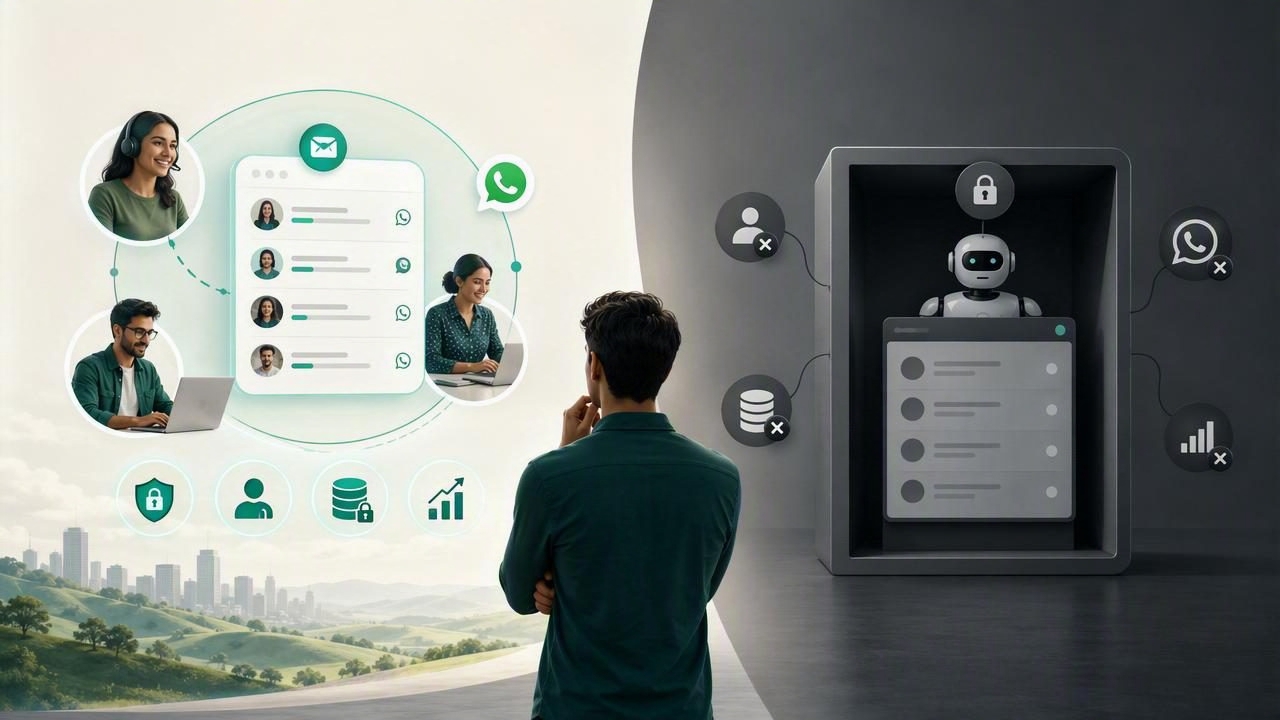
For agencies deploying AI assistants across WhatsApp, web chat, and other customer channels, automation is only one part of the service. The other part is what happens when automation reaches its limit. A prospect may ask for a custom quote, a customer may report an urgent problem, or an AI agent may encounter information that is missing from its knowledge base.
That is where the human handoff inbox vs closed AI agency platforms comparison becomes important. Both approaches can help an agency launch conversational AI for clients, but they create very different operating models. One prioritizes flexible oversight, direct access, and human intervention. The other prioritizes a simplified, vendor-controlled workflow that may be faster to start but harder to adapt.
This guide explains the practical differences, the trade-offs to assess, and how agencies can choose a platform model that supports reliable client delivery rather than impressive demos alone.
What Is a Human Handoff Inbox?
A human handoff inbox is a shared workspace where agency operators or client team members can review AI conversations and take over when necessary. It connects the AI agent to a real person without forcing the customer to restart the conversation, repeat their question, or move to a separate support channel.
In a well-designed handoff flow, the agent identifies an escalation condition, summarizes the conversation context, assigns or routes the case, and lets an authorized human respond from the same conversation thread. On WhatsApp, this continuity is especially valuable because customers expect quick, personal responses in one familiar channel.
Common triggers for a handoff
- A lead asks about pricing, contracts, or a bespoke proposal.
- A customer expresses frustration, urgency, or a complaint.
- The AI agent has low confidence in its answer.
- The request requires account-specific access or approval.
- A regulated, financial, legal, or medical question needs human review.
- The customer explicitly asks to speak with a person.
Human handoff is not a failure of AI. It is a service design feature. The strongest AI agent deployments automate predictable work while making escalation easy, safe, and visible.
What Are Closed AI Agency Platforms?
Closed AI agency platforms are proprietary systems where the vendor controls the application code, infrastructure decisions, integrations, feature roadmap, and sometimes the model choices available to agencies. They often package agent building, branding, analytics, and deployment into one hosted product.
These platforms can be useful for agencies that want a quick path to deployment with minimal technical setup. However, the convenience can come with constraints. The vendor may dictate how conversation data is stored, which inbox features are available, how client workspaces are separated, and whether agencies can export data or customize workflows.
Closed does not automatically mean insecure or low quality. The key issue is control. Agencies should understand which decisions remain theirs and which are delegated to the platform vendor before building a recurring service around it.
Human Handoff Inbox vs Closed AI Agency Platforms: Core Differences
| Evaluation Area | Human Handoff Inbox Approach | Closed Platform Approach |
|---|---|---|
| Conversation ownership | Usually emphasizes agent and client team access to live conversations. | Access rules and exports depend on vendor policies. |
| Escalation workflow | Can support routing, assignment, notes, and direct takeover. | May offer basic escalation but limited customization. |
| Client isolation | Can be designed with separate client workspaces and permissions. | Often available, but implementation visibility varies. |
| AI model flexibility | May support OpenAI-compatible models and provider choice. | Often limited to vendor-selected models or plans. |
| Customization | Potentially adaptable to agency-specific workflows. | Usually limited to product settings and approved integrations. |
| Vendor dependency | Lower when software can be self-hosted or exported. | Higher because infrastructure and roadmap are vendor-controlled. |
Why the Inbox Matters for Agency Operations
Agencies do not merely deploy bots. They manage client expectations, protect brand reputation, and prove ongoing value. An inbox turns an AI agent from a standalone automation into an operational layer that client teams can trust.
Consider a property management agency client using a WhatsApp AI agent. The agent can answer questions about viewing availability, required documents, and office hours. But when a tenant reports a water leak, the conversation must be escalated immediately. A human handoff inbox lets the property manager see the entire discussion, identify the address and urgency, and respond without delay.
Without this capability, the AI may keep attempting to answer, send the customer to an email address, or create a disjointed experience. That risks undermining both the client relationship and the agency's credibility.
Operational benefits of a shared inbox
- Faster resolution: Humans receive context rather than starting from zero.
- Clear accountability: Conversations can be assigned to a person or team.
- Better quality control: Agency teams can audit AI responses and spot knowledge gaps.
- Stronger reporting: Escalation volume can reveal where automation needs improvement.
- Client confidence: Clients know they retain control over sensitive conversations.
Data Security and Client Separation
Multi-client agency operations need more than a single dashboard with multiple agent names. Each client should have properly isolated knowledge sources, conversations, credentials, and permissions. If an operator supports several brands, the system should make it difficult to accidentally view, edit, or send messages in the wrong client environment.
When evaluating a human handoff inbox, ask whether roles can be restricted by client, whether conversation history is segregated, and whether knowledge base documents are attached only to the intended agent. This is particularly important for agencies serving competitors, franchises, healthcare providers, legal firms, or businesses handling customer financial data.
Practical rule: A shared agency team does not require shared client data. Use workspace boundaries and least-privilege permissions from the start.
Closed platforms may offer tenant separation, but agencies should request clear answers about data retention, export controls, audit logs, hosting regions, and administrator access. For businesses with strict requirements, self-hosted AI software can provide additional infrastructure control, although it also creates responsibility for updates, backups, monitoring, and access management.
Questions to Ask Before Choosing a Platform
The best option depends on your agency's technical capacity, client profile, pricing model, and support commitment. Instead of choosing solely based on agent demos, review the full operating workflow.
- Can a person take over a live WhatsApp conversation? Confirm whether takeover happens in the same thread and preserves history.
- How are escalations triggered? Look for manual, keyword-based, confidence-based, and customer-requested handoff options.
- Can client staff access only their own inbox? Verify granular roles for agency admins, client admins, and operators.
- Can you connect your preferred models? OpenAI-compatible model support can reduce dependency and help manage cost or performance.
- Can you export conversations and knowledge data? Data portability matters when clients change systems or contracts end.
- Can you customize the workflow? Assess APIs, webhooks, routing rules, CRM integration, and branding needs.
- Who owns support during an outage? Clarify service-level expectations for the vendor, agency, and client team.
Build a Better Human Handoff Workflow
A handoff process should be explicit, not improvised. Define when the AI agent should continue, when it should request clarification, and when it must escalate. Then measure the results over time.
IF customer_requests_human = true
  THEN assign_to = "client_support_team"

IF intent = "custom_quote"
  THEN assign_to = "sales_team"

IF sentiment = "urgent" OR topic = "safety_issue"
  THEN assign_to = "priority_queue"
  AND notify = "on_call_manager"
The exact implementation will vary, but the operating principle stays the same: use automation to collect information and route work, while giving humans authority over exceptions and sensitive decisions.
Review handoff conversations monthly. If the same question repeatedly reaches a human, improve the client knowledge base, add an approved answer, or adjust the AI agent's instructions. If the AI is escalating too rarely, it may be overconfident. If it escalates too often, the intake flow may need refinement.
Choosing for Long-Term Agency Revenue
A closed platform may be suitable when speed matters most, requirements are simple, and clients accept the vendor's standard workflow. A human-centered inbox model is often better when agencies want to deliver a managed service, retain operational visibility, and support clients with different rules, teams, and escalation paths.
Ultimately, the human handoff inbox vs closed AI agency platforms decision is about more than features. It is about whether your agency can maintain service quality as client volume grows. Prioritize client isolation, reliable handoff, permission controls, knowledge base management, and data portability before committing to a delivery model.
For agencies seeking an open-source option with isolated client agents, knowledge bases, conversations, and human handoff capabilities, OpenLivery is one platform worth evaluating alongside your operational and hosting requirements.
