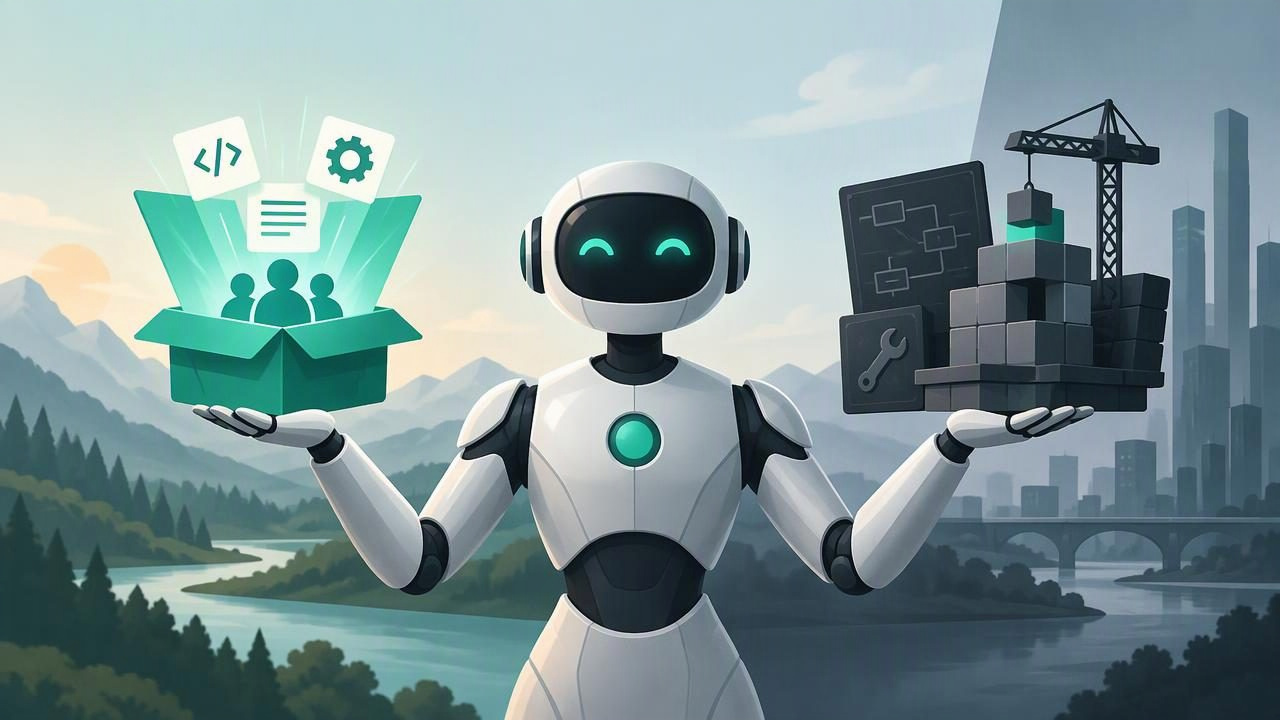
Agencies building WhatsApp automation face an important choice: adopt an open source AI agent platform or develop a separate custom bot project for each client. Both approaches can deliver useful conversations, answer questions, and qualify leads. The difference lies in what your team must build, operate, and maintain as client needs grow.
The right option depends on more than the first demo. Consider the full operating model: how you manage multiple clients, update knowledge, control model costs, protect data, and hand conversations to people. This guide compares the approaches and offers a practical framework for deciding which fits your agency.
What is an open source AI agent platform?
An open source AI agent platform provides reusable infrastructure for creating, deploying, and managing AI agents. Depending on the product, it may include client workspaces, conversation storage, integrations, knowledge retrieval, model configuration, and tools for human handoff. The source code can be inspected and, where the license permits, modified or self-hosted.
For agencies, the central advantage is a shared operational foundation. Instead of rebuilding the same functions for every account, a team can set up separate agents and client knowledge bases within a repeatable system. Each client should still have clearly isolated conversations, credentials, settings, and content. Open source does not automatically guarantee those controls; the agency needs to verify how the platform implements them.
What is a custom bot project?
A custom bot project is software developed specifically for one client or use case. The agency may write the application, connect a messaging channel, choose a model, create retrieval logic, and build an administration interface from scratch. A project can also start from an existing framework or template, so “custom” does not always mean every line of code is new.
This approach offers a high degree of design freedom. A client with unusual workflows, legacy systems, or strict technical requirements may need behavior that a general platform does not support. The trade-off is ownership of the whole lifecycle: testing, deployment, monitoring, upgrades, security fixes, and future changes.
Platform vs custom project: the main differences
| Decision area | Open source AI agent platform | Custom bot project |
|---|---|---|
| Starting point | Reusable application and operations | Client-specific design and code |
| Customization | Configuration plus permitted extensions | Broad control over product behavior |
| Multi-client management | May provide workspaces and shared administration | Must be designed and maintained |
| Ongoing responsibility | Agency operates or extends a foundation | Agency owns more of the software lifecycle |
| Best fit | Repeatable services across several clients | Distinctive requirements that justify bespoke work |
These are typical patterns, not guarantees. A platform may require substantial implementation work, while a well-designed custom system can reuse components. Compare actual capabilities, license terms, and staffing needs rather than relying on labels.
1. Compare the full cost, not just the first build
A custom bot can look economical when the initial scope is small. But the first estimate may not include ongoing model integration, channel changes, hosting, incident response, documentation, analytics, or client requests that arrive after launch. If every client has a separate codebase, even routine fixes can multiply into repeated work.
A platform usually shifts effort toward configuration, onboarding, integration, and operations. There may be hosting or subscription costs, and an open source license does not make infrastructure or support free. Still, reusable features can reduce duplicated development when the agency serves clients with similar needs.
Estimate total cost over a realistic period. Include engineering hours, cloud and messaging fees, model usage, maintenance, security work, and the time account teams spend making changes. Also estimate the revenue opportunity: a standardized service can make delivery more predictable and support recurring agency revenue, provided each client receives clear value.
2. Evaluate multi-client operations and isolation
One bot for one business is relatively straightforward. Managing many branded WhatsApp agents introduces a different set of requirements. Staff need to move between accounts without mixing client data. Each client may need its own instructions, documents, model settings, escalation rules, and conversation history.
Ask how the architecture separates those elements. Is isolation enforced by the application, the database, permissions, or a combination? Can an operator access only assigned clients? Are administrator actions recorded? What happens when a team member leaves or a client relationship ends? These questions matter whether your system is open source or custom-built.
A platform designed for multi-client agency operations may offer a common view of accounts and repeatable setup steps. In a custom project, those features can be built to your exact process, but they also become part of your long-term maintenance burden. Test permissions using realistic roles instead of assuming that separate screens mean data is isolated.
3. Check model choice and client knowledge workflows
AI services change quickly, and different clients may have different needs for latency, cost, language support, or hosting. An open source AI agent platform that supports OpenAI-compatible models can make it easier to connect providers that expose compatible interfaces. Confirm which settings are configurable per client and whether changing a model requires code changes.
Custom projects can integrate almost any model or retrieval approach, but flexibility comes with testing responsibilities. Your team must check how the bot responds to unsupported questions, handles changing model behavior, and uses client-provided PDFs or other source material. A knowledge base also needs an update process: someone must review new documents, remove outdated information, and test representative questions.
Regardless of architecture, do not treat a successful answer in a demo as proof that the knowledge workflow is reliable. Test common questions, ambiguous requests, missing information, and conflicting documents. Make it easy to identify the source of an answer where practical, and define when the agent should ask a clarifying question or stop and escalate.
4. Plan for human handoff and safe failure
Automating every conversation is rarely a sound goal. Customers may request a person, raise a sensitive issue, or ask about something the agent cannot verify. Decide what triggers a human handoff, who receives the conversation, and how the agent pauses while a staff member responds.
A platform may provide handoff controls or make it possible to add them through an integration. A custom bot can implement a tailored routing process, such as assigning messages by location or service type. Either way, test the complete journey: the user asks for help, the agent acknowledges the request, a human receives enough context, and automated replies do not interrupt the live conversation.
Define fallback behavior for unavailable staff, messaging outages, model errors, and low-confidence answers. Clear limits protect the customer experience and help prevent an agent from presenting guesses as facts.
5. Consider security, permissions, and deployment
Security is a system property, not a benefit guaranteed by choosing open source. Review authentication, role-based permissions, data retention, backups, logging, encryption, secret management, and dependency updates. Establish who can export conversations, change prompts, upload documents, or connect a model provider. Keep client data and credentials separate, and document how data is deleted when a contract ends.
Self-hosted AI software gives an agency more control over infrastructure and deployment, but requires staff to patch, monitor, back up, and secure that environment. A managed AI agent cloud can reduce infrastructure work, though the agency still needs to understand its provider’s security practices, data handling, and service limits. Custom software has the same deployment choices—and the same operational duties.
When should an agency choose each approach?
An open source platform is a strong candidate when:
- You serve multiple clients with similar agent needs and want a repeatable delivery process.
- Your team wants to inspect or extend the underlying software rather than depend entirely on a closed product.
- Client work requires separate knowledge, conversations, branding, or model settings within one operational environment.
- You can accept the platform’s architecture or adapt it without turning every deployment into a separate fork.
A custom bot project may be the better fit when:
- A client has a genuinely unusual workflow, deep system integration, or specialized user experience.
- Existing platforms cannot meet a documented requirement after a fair technical evaluation.
- The client can fund development and ongoing maintenance, and your agency has the skills to support it.
- The bespoke capability is strategically valuable enough to justify owning more code and operational risk.
There is also a practical middle ground. Use a platform for common capabilities—such as account administration, conversations, and knowledge management—then build a focused integration or extension for the client-specific part. This avoids rebuilding standard operations while preserving room for differentiation.
A practical decision process
- List requirements: Separate must-haves from preferences, including channels, integrations, branding, handoff, and hosting.
- Model three-year effort: Estimate implementation, upgrades, support, infrastructure, and per-client onboarding for both approaches.
- Run a representative pilot: Use real workflow examples and realistic client documents, with permission and appropriate safeguards.
- Test isolation and failure cases: Try role changes, incorrect questions, human escalation, and removal of a test client.
- Set an exit plan: Confirm how you can export data, replace a model, migrate clients, or maintain a fork if circumstances change.
Score each option against the same criteria: delivery speed, total cost, operational fit, adaptability, security controls, and team capability. A short pilot is more informative than a long feature checklist, especially when it tests the work your agency actually performs after launch.
The bottom line
The choice between an open source AI agent platform and custom bot projects is a choice about where your agency wants to invest its effort. A platform can make repeatable, multi-client operations easier when its features and architecture match your needs. Custom development can unlock specialized experiences, but it also makes your team responsible for more of the software lifecycle.
Start with client outcomes and operating requirements, not the assumption that one approach is always cheaper or more flexible. Validate isolation, permissions, model options, knowledge updates, and human handoff before committing. Agencies exploring a reusable foundation can include OpenLivery among the platforms they evaluate, alongside a clear assessment of their own technical and service requirements.
