AI automation agencies are increasingly expected to deliver more than simple chatbots. Clients want branded AI agents that can answer questions, access approved knowledge, qualify leads, book meetings, and transfer complex conversations to human teams. At the same time, agencies need a reliable way to operate many client accounts without mixing data, losing control of costs, or becoming dependent on a vendor’s roadmap.
That is why self hosted AI agent software for AI automation agencies has become an important category. Self-hosting gives agencies greater control over infrastructure, data, model providers, integrations, permissions, and customer experience. It can also create a stronger foundation for recurring revenue when an agency manages AI agents as an ongoing service.
This guide explains what self-hosted AI agent software is, what features agencies should prioritize, how to evaluate deployment options, and how to build a secure multi-client operating model.
What Is Self-Hosted AI Agent Software?
Self-hosted AI agent software is a platform that an agency runs in its own cloud account, private server, or controlled infrastructure. Instead of relying entirely on a shared software-as-a-service environment, the agency controls where the application, database, files, logs, and credentials are stored.
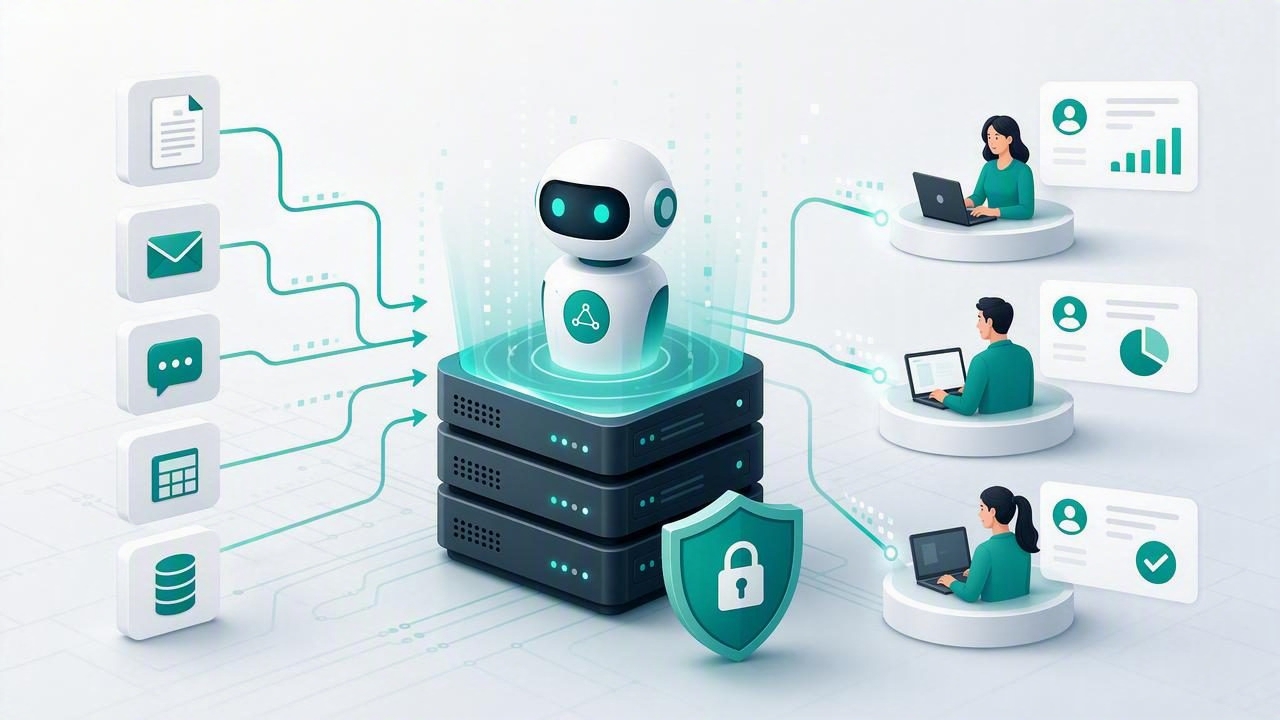
An AI agent is more than a language model connected to a chat window. A useful production agent typically combines several components:
- A conversation channel, such as WhatsApp, web chat, or an internal support portal.
- A model layer that connects to OpenAI-compatible APIs or other approved model providers.
- A knowledge base containing client documents, FAQs, product details, policies, and procedures.
- Business logic for lead qualification, routing, scheduling, CRM updates, or workflow triggers.
- Human handoff controls for cases that require a sales representative, support specialist, or account manager.
- Permissions and auditability to ensure the right people can access the right client data.
For an agency, the key difference is operational: the platform must support multiple client environments without making every deployment a custom engineering project.
Why Agencies Choose a Self-Hosted Model
A managed cloud platform can be convenient, especially for early pilots. However, self-hosting becomes attractive when agencies need more control over client data and service delivery. The right choice depends on technical capacity, customer requirements, margins, and the level of customization needed.
| Consideration | Managed Cloud | Self-Hosted Deployment |
|---|---|---|
| Setup speed | Usually faster | Requires initial infrastructure setup |
| Data location control | Limited by provider architecture | Agency chooses hosting region and environment |
| Customization | Often constrained by product roadmap | Can adapt code, integrations, and workflows |
| Maintenance | Provider handles most operations | Agency or technical partner manages operations |
| Client white-labeling | May be limited | Greater control over branding and domains |
| Long-term cost control | Subscription pricing can rise with usage | Infrastructure costs can be optimized directly |
Self-hosting is not automatically the best answer. It introduces responsibility for backups, patching, monitoring, incident response, and deployment processes. But for agencies selling higher-value automation services, those responsibilities can be worthwhile because they support differentiated offerings and stronger client trust.
Essential Features for Multi-Client Agency Operations
Not all agent platforms are designed for agencies. A tool built for one internal business team may become difficult to manage when an agency has ten, fifty, or hundreds of clients. Look for capabilities that reduce operational overhead as your portfolio grows.
Tenant Isolation
Each client should have isolated conversations, knowledge sources, users, credentials, and agent settings. Isolation prevents accidental exposure of one client’s documents or messages to another client’s team. At a minimum, the platform should enforce tenant-aware access controls at the application and database layers.
For high-sensitivity use cases, agencies may also offer separate deployments or databases for enterprise clients. This adds cost, but it can be appropriate for legal, healthcare, financial, or regulated organizations.
Knowledge Base Management
AI agents need accurate, current information. A strong knowledge base workflow lets an agency upload PDFs, FAQs, webpages, product catalogs, and internal procedures, then organize those sources by client and agent. The system should make it easy to replace outdated files, identify source material, and test answers before publication.
Ask whether the platform supports retrieval controls, source citations, document chunking, and access restrictions. These features help reduce hallucinations and make it easier to investigate why an agent gave a particular answer.
Model Flexibility
Agencies should avoid locking every client into one model provider. OpenAI-compatible model support makes it easier to choose models based on language quality, latency, cost, region, or client policy. For example, one client may prioritize the strongest reasoning model, while another needs lower-cost responses for high-volume lead capture.
Model flexibility also improves resilience. If one provider experiences an outage or changes pricing, the agency has a clearer path to testing alternatives.
Human Handoff and Conversation Ownership
Automation should not trap users in a loop. A good agent must recognize when a person needs help and route the conversation correctly. Human handoff can be triggered by keywords, negative sentiment, low-confidence answers, requests for pricing, or lead qualification thresholds.
The purpose of an AI agent is not to eliminate every human interaction. It is to make human interactions more timely, informed, and valuable.
For WhatsApp AI agents, handoff design is especially important because customers expect fast, natural replies. Make sure the human team can view context, see the conversation history, and know which knowledge sources or actions the agent used.
Security and Permissions Should Be Built In
Security is not just an enterprise checkbox. It is central to agency reputation. If your team operates branded agents for multiple businesses, a permissions mistake can affect several contracts at once.
Use a layered security approach:
- Role-based access control: Give agency administrators, client administrators, operators, and viewers only the permissions they need.
- Separate secrets: Store API keys, WhatsApp credentials, CRM tokens, and webhooks per client whenever possible.
- Encryption: Protect data in transit with TLS and encrypt sensitive stored data using your cloud provider’s controls.
- Audit logs: Track logins, configuration changes, document uploads, exports, and permission updates.
- Retention policies: Define how long conversations, documents, and logs remain available.
- Backup and recovery testing: Backups are only useful when restoration procedures have been tested.
Also consider prompt injection risks. Documents and user messages may contain instructions intended to manipulate the agent. Establish clear system instructions, restrict which tools the agent can call, validate tool inputs, and avoid allowing the model to access sensitive actions without explicit controls.
A Practical Self-Hosting Architecture
A typical agency deployment uses containerized services so that environments can be reproduced consistently. The exact architecture varies, but a practical foundation includes an application frontend, API service, PostgreSQL database, document storage, and a reverse proxy.
services:
  app:
    image: agency-agent-platform:latest
    environment:
      DATABASE_URL: postgresql://agent_user:secure_password@db:5432/agents
      MODEL_API_BASE: https://api.model-provider.example/v1
    depends_on:
      - db
  db:
    image: postgres:16
    volumes:
      - postgres_data:/var/lib/postgresql/data
volumes:
  postgres_data:
This example is intentionally simple. A production environment should add a secrets manager, HTTPS termination, private networking, automated backups, uptime monitoring, centralized logging, and separate staging and production environments. Agencies should never place production passwords directly in a public repository or long-lived configuration file.
How to Evaluate Platforms Before Committing
Before selecting software, run a real pilot with a representative client workflow. Avoid evaluating an AI agent only through a polished demo. Test it against the questions, documents, integrations, and operational constraints that will exist after launch.
- Can you create isolated client workspaces without custom development?
- Can client documents be updated without rebuilding the entire agent?
- Does the platform support WhatsApp, web chat, or your required channels?
- Can the agent transfer conversations to people with full context?
- Are models configurable through OpenAI-compatible endpoints?
- Can you export data and migrate if needed?
- Does the codebase, documentation, and deployment process match your team’s technical skills?
- Can you monitor errors, usage, response quality, and handoff rates?
Measure pilot outcomes using business metrics, not only model quality. Useful indicators include qualified leads, response time, human handoff rate, booked appointments, resolution rate, cost per conversation, and customer satisfaction.
Turning Agent Operations Into Recurring Revenue
Self-hosted software does not create agency revenue by itself. The value comes from the managed service around it. Agencies can package strategy, knowledge base preparation, agent configuration, WhatsApp setup, integration work, monitoring, optimization, and monthly reporting.
A sensible service model often includes a one-time implementation fee plus a monthly management plan. The management plan can cover a defined number of conversations, knowledge base updates, performance reviews, and support hours. Usage-based overages can protect margins when a client’s volume grows.
Standardizing your onboarding process is essential. Create reusable templates for discovery calls, document requests, tone-of-voice rules, escalation paths, lead qualification questions, and acceptance testing. Consistency makes a multi-client agency more profitable and reduces launch time.
Final Takeaway
Choosing self-hosted AI agent software is fundamentally a decision about control and operational maturity. Agencies gain the most value when they combine secure tenant isolation, flexible model access, reliable knowledge management, thoughtful human handoff, and repeatable deployment practices.
Start with one focused use case, document the operating process, and improve the agent using real conversation data. For agencies seeking an open-source foundation with multi-client agent operations and WhatsApp workflows, OpenLivery is one option to explore.
