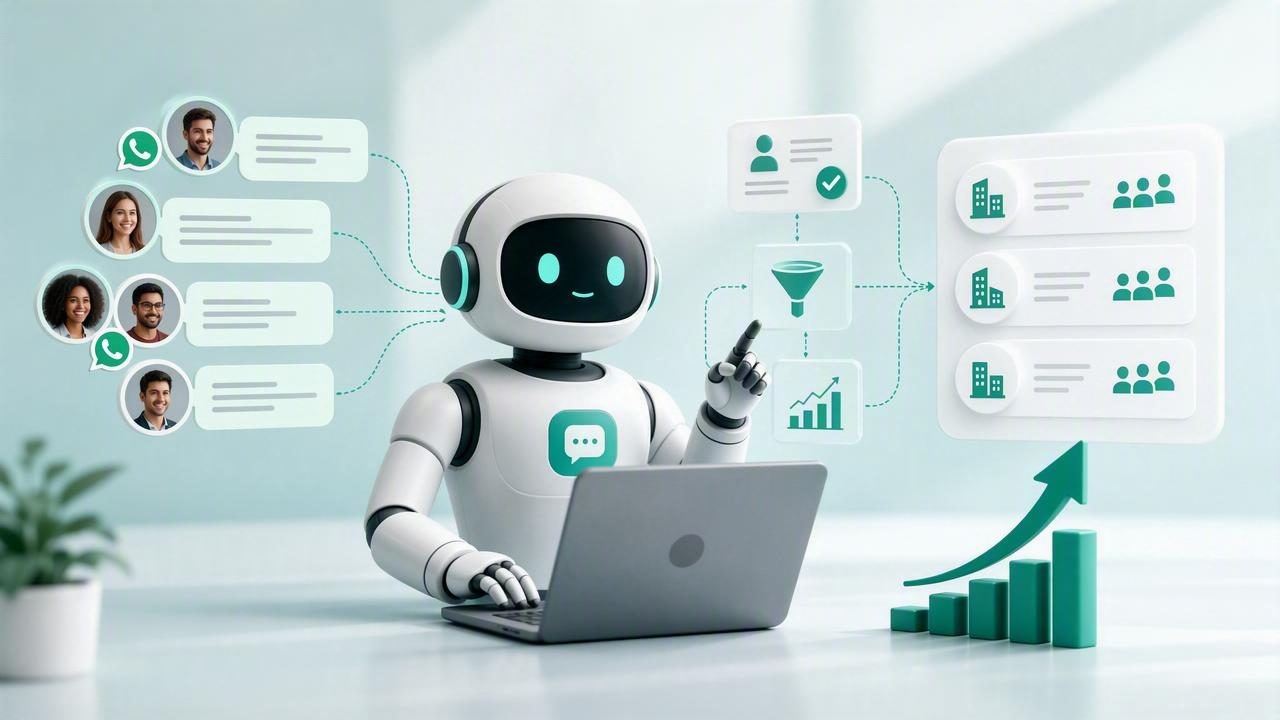
A plataforma white label de agentes de ia para agencias de generacion de leads can help agencies deliver faster lead response, consistent qualification, and scalable client service without building an AI product from scratch. Instead of treating artificial intelligence as a one-off chatbot project, agencies can use branded AI agents as a repeatable service across their client portfolio.
This approach is especially valuable for lead generation agencies managing high volumes of WhatsApp, website, and campaign inquiries. Prospects expect immediate answers, but agency teams and client sales staff cannot be available around the clock. A properly configured AI agent can answer common questions, gather qualification details, identify buying intent, and route high-value conversations to a human at the right time.
However, successful deployment requires more than connecting a language model to a messaging inbox. Agencies need client isolation, reliable knowledge management, permission controls, human handoff workflows, and a commercial model that supports recurring revenue.
What Is a White-Label AI Agent Platform?
A white-label AI agent platform enables an agency to provide AI-powered conversational experiences under its own brand. The agency can configure agents for individual clients while presenting the service as part of its own lead generation, automation, or customer engagement offering.
In practice, each client may receive a dedicated AI agent with its own:
- Brand voice, business information, and lead qualification rules
- Knowledge base containing approved documents, FAQs, services, and policies
- Messaging channels, such as WhatsApp or website chat
- Conversation history and lead records
- User access permissions for agency and client team members
- Human escalation rules and sales-team notifications
The white-label component matters because agencies are not merely reselling generic software. They are packaging strategy, setup, content curation, workflow design, optimization, and reporting into a branded, ongoing service.
Why Lead Generation Agencies Are Adopting AI Agents
Traditional lead generation often has a weak point after the lead arrives. Paid ads, landing pages, and social campaigns may produce inquiries, but slow follow-up can dramatically reduce conversion rates. AI agents close part of that gap by responding immediately and consistently.
For example, a property marketing agency may generate WhatsApp inquiries for several real estate developers. Each developer needs different project details, locations, budgets, availability, and financing information. Rather than having an agency coordinator manually answer every first message, a dedicated AI agent can collect the prospect’s preferred area, property type, budget range, and purchase timeline before handing qualified leads to the sales team.
This creates value on both sides: the client receives better-qualified opportunities, while the agency can prove that its campaigns influence not just lead volume but also lead quality and response speed.
Core benefits for agencies
- 24/7 first response: Answer leads while interest is high, including outside business hours.
- Standardized qualification: Ask consistent questions across campaigns and client accounts.
- Higher team capacity: Let staff focus on complex conversations and closing opportunities.
- Reusable operations: Turn successful agent configurations into templates for similar verticals.
- Recurring revenue: Combine setup, monthly management, knowledge-base updates, and reporting.
Essential Features to Evaluate
Not every AI chatbot tool is designed for an agency environment. A platform that works for one internal business team may become difficult to manage when an agency supports ten, fifty, or hundreds of clients. Evaluate the following capabilities before standardizing on a solution.
| Capability | Why It Matters for Agencies | What Good Looks Like |
|---|---|---|
| Client isolation | Prevents information and conversations from crossing accounts. | Separate agents, knowledge bases, users, and conversation data per client. |
| WhatsApp integration | Many leads prefer messaging over forms or email. | Reliable inbound handling, context retention, and clear escalation paths. |
| Knowledge management | Agent answers are only as dependable as their source material. | Client-specific PDFs, FAQs, URLs, and editable instructions. |
| Human handoff | AI should support sales teams, not block them. | Notifications, assignment, status tracking, and transcript visibility. |
| Model flexibility | Costs, languages, and performance needs vary by client. | Support for OpenAI-compatible models and configurable model choices. |
| Roles and permissions | Agency and client users need different levels of access. | Granular controls for administrators, operators, and client viewers. |
Build a Lead Qualification Workflow Before Training the Agent
The strongest AI agents follow a defined business workflow. Before uploading documents or writing prompts, map the lead journey from the first message to a booked meeting, CRM update, or sales handoff.
Start with questions that the client’s sales team genuinely uses to prioritize leads. For a B2B service business, that may include company size, current challenge, decision-maker role, budget range, and implementation timeline. For an education provider, it could include program interest, location, start date, and preferred study format.
Example qualification sequence
- Greet the prospect and identify the service or offer they are asking about.
- Answer the immediate question using approved client knowledge.
- Ask one relevant qualification question at a time.
- Summarize captured information in a structured format.
- Identify a handoff trigger, such as high intent, pricing request, or appointment readiness.
- Notify or assign the conversation to a human sales representative.
Avoid turning the interaction into a long form disguised as chat. The agent should earn the right to ask questions by first being useful. If a prospect asks, “Do you offer delivery in my area?”, answer that question clearly before requesting their contact details or budget.
Lead handoff trigger:
IF prospect.timeline <= 30 days
AND prospect.budget_confirmed = true
AND prospect.intent IN ["book demo", "request quote", "buy"]
THEN assign_to = "sales_team"
AND notify = "priority_lead_channel"
Protect Client Data With Isolation and Permissions
Multi-client operations create a major responsibility: one client’s knowledge, lead data, and conversations must never be exposed to another client. This is not simply a technical preference. It is fundamental to agency trust, contractual commitments, and data security.
Agencies should use a tenant-based structure where every client has a logically separated workspace. Each workspace should have its own documents, agent configuration, messaging credentials, and user access. Agency administrators may need cross-client visibility, but client users should only see their own environment.
Rule of thumb: If an account manager accidentally selects the wrong client workspace, the platform should still prevent them from viewing or using data they are not authorized to access.
Also establish a practical governance process. Decide who can upload knowledge-base materials, approve prompt changes, connect a messaging number, export conversations, and invite users. Document these responsibilities before onboarding clients at scale.
Use Knowledge Bases Carefully
Client knowledge bases make AI agents more useful, but uploading every available file is not the same as creating a reliable answer system. Outdated brochures, conflicting price sheets, and incomplete PDFs can cause inconsistent replies.
For each client, create a small set of approved source materials and review them regularly. Organize content around the questions prospects actually ask: offerings, eligibility, pricing guidance, locations, availability, differentiators, and next steps. Where information changes frequently, such as inventory or promotions, use clear update ownership and expiration dates.
The agent should also be instructed to avoid guessing. When reliable information is unavailable, it should say so, capture the question, and offer human follow-up. Accuracy is more valuable than a confident but incorrect answer.
Package AI Agents as an Agency Service
A white-label AI agent service is easiest to sell when the offer is tied to measurable client outcomes. Rather than positioning it as “an AI chatbot,” frame it around faster response times, better lead qualification, more booked calls, or reduced manual workload.
A practical service package can include:
- Initial discovery and qualification-flow design
- Agent setup, brand voice configuration, and knowledge-base preparation
- WhatsApp or web-chat deployment
- Human handoff and sales notification setup
- Monthly conversation review and prompt optimization
- Knowledge updates and performance reporting
Pricing often works best as a one-time implementation fee plus a monthly management fee. Agencies can also create tiers based on the number of channels, agents, conversations, users, or client locations. The right model should account for AI usage costs, support requirements, and the strategic value the agency provides.
Measure the Metrics That Matter
Do not evaluate an AI agent solely by the number of conversations it handles. Track the outcomes that relate to lead generation performance and client revenue.
- Median first-response time
- Percentage of conversations answered without human intervention
- Lead qualification completion rate
- Qualified leads handed to sales
- Appointments or demos booked
- Human escalation rate and the reasons behind it
- Common unanswered questions that reveal knowledge gaps
Review transcripts on a recurring schedule. Look for points where prospects disengage, questions the agent misunderstands, and repeated requests that should become new knowledge-base entries. Continuous improvement is where agencies build a meaningful advantage over generic, static chatbot deployments.
Choose a Deployment Model That Fits Your Agency
Managed cloud platforms reduce operational overhead and are usually the fastest way to launch. Self-hosted AI software can be a better fit for agencies with strict data residency requirements, advanced customization needs, or internal technical resources. An open-source architecture may also reduce vendor dependence and make integrations easier to control.
Whichever route you choose, prioritize reliable client separation, transparent model configuration, secure credential handling, backups, auditability, and a clear path for scaling your support process.
For agencies seeking an open-source foundation for branded WhatsApp agents and isolated client workspaces, OpenLivery is one option to explore alongside your workflow, security, and deployment requirements.
